Sunday, December 12, 2021

The San Francisco Ballet Returns

After the triumphant returns this fall of both the San Francisco Opera and the San Francisco Symphony across Grove Street, it was finally San Francisco Ballet's turn for resurrection on Friday night. This was after the company was suddenly shut down mid-season in March of 2020 when the pandemic arrived.
Tchaikovsky's 1892 Nutcracker was a particularly fitting vehicle for the San Francisco Ballet's return since the company gave the ballet's first full-length performances in the U.S. in 1944, ten years before Balanchine staged his version with the New York City Ballet and a couple of decades before it became a Christmas perennial all over the world in the 1960s. (All production photos by Erik Tomasson.)
The timing also felt apt because this is the last year for Artistic Director Helgi Tomasson before his retirement from the company he has led for 37 years, and the 2004 Nutcracker is one of his best productions, set in a 1915 San Francisco Victorian before journeying into an enchanted dreamland.
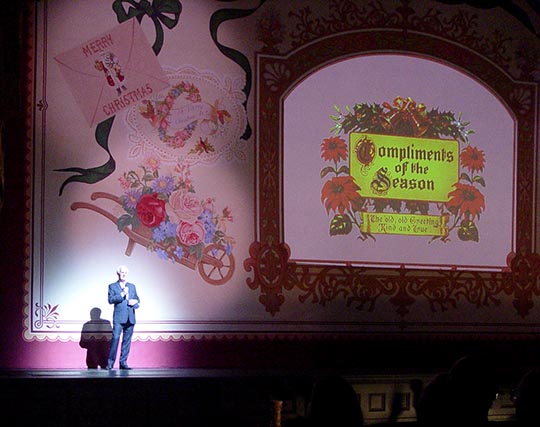
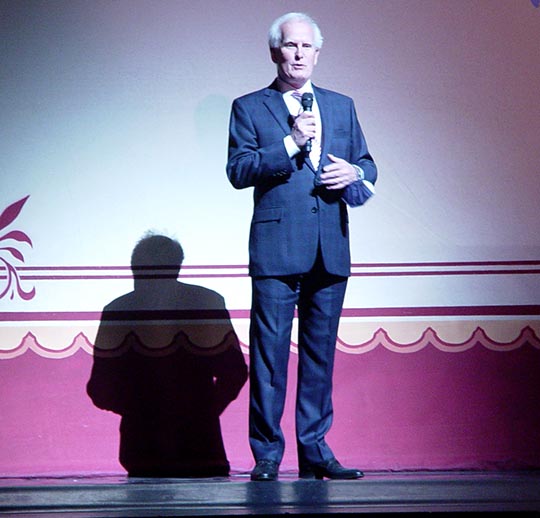
Tomasson came onstage before the show and gave a short, emotional, heartfelt welcome to the audience which roared back in happiness.
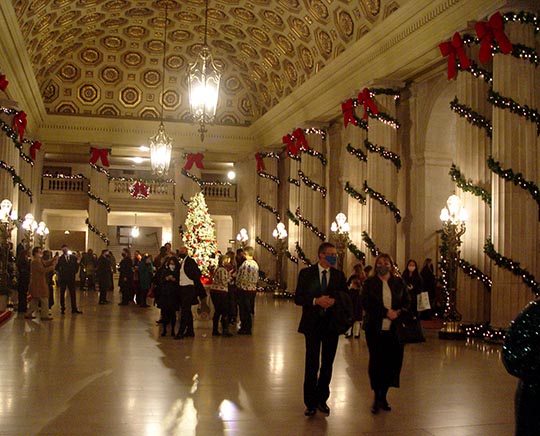
Following the lead of both SF Opera and SF Symphony, proof of vaccination was required for entry and from what I observed, just about everyone was conscientious about wearing their masks inside the auditorium.
The opening audience was a delightful mixture of little girls in princess dresses...
...what looked to be ballet students...
...and multi-generational family groups where the SF Ballet Nutcracker is an annual tradition.
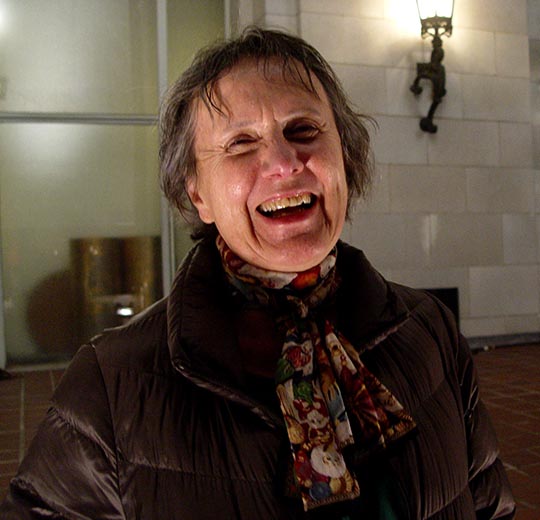
On the Grand Tier outdoor balcony, we ran into Andrea Kohlruss, who I met when we were supernumerary slaves in a legendary 1991 SF Opera production of Elektra. In 2004, she was offered a cameo role in the new production of Nutcracker as a nun crossing the stage during the Prologue, and she's been doing it ever since, except this year because supernumeraries were replaced by members of the ballet company as a COVID precaution.
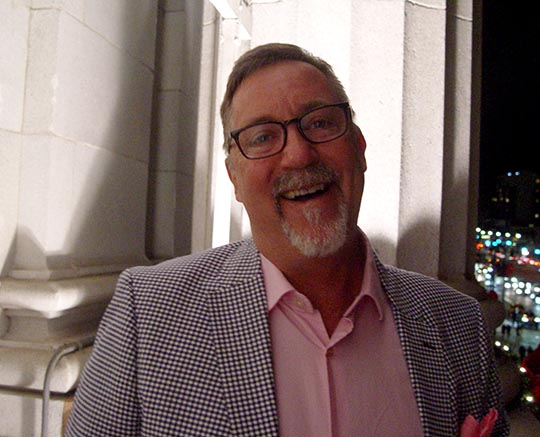
Austin had never seen a professional production of Nutcracker before, and he was unreasonably excited beforehand.
When asked afterwards what he tought of the production, Austin replied, "It exceeded all expectations."
The standout dancer of the evening was Joseph Walsh as the Nutcracker who is actually a Handsome Prince. His style is less flashy than it is elegant, with landings from leaps that look effortless, weightless, and altogether beautiful. He was also a gallant partner for his various ballerinas, who all seemed to dance better when he joined them.
The greatest joy for me was listening to the SF Ballet orchestra perform Tchaikovsky's score with both delicacy and passion under longtime Music Director Martin West. There was nothing routine about the playing and it was a potent reminder of how gorgeous this musical score can be.
There are 25+ performances remaining before New Years Day at the SF Opera House (click here). The snowstorm finale of Act I is worth the price of admission alone.

Sunday, December 05, 2021

Messalina and Cosi Fan Tutte

I saw two marvelous Italian opera productions in San Francisco recently and they both focused obsessively on female virtue as a motivating plot device. (Production photos are by Valentina Sadioul.)
The first offering at the ODC Theater was the low-budget, high-creative Ars Minerva production of Messalina, a 1679 Venetian Carnival opera by the composer Carlo Pallavicino featuring the licentious title Roman Empress who was married to the Emperor Claudius. She was reputed to have infamously cuckolded him with a series of lovers before her eventual execution, and her name is still a byword for slut in Italy. The soprano Aura Veruni was a silly, horny Empress in one fabulously crazy costume after another (designed by Marina Polakoff), and her clueless, sexually predatory Emperor was sung by Deborah Rosengaus. They both sounded wonderful, and seemed to enjoy playing bored, upper-crust characters straight out of La Dolce Vita. This must have come as a relief to Aura Veruni, since she was in danger of being sacrificed in Ars Minerva's 2018 production of Ifigenia in Aulide and raped by another Roman emperor last summer in West Edge Opera's Cavalli opera, Eliogobalo.
The other two couples were Kevin Gino as Tullio who is jealously paranoid about his virtuous wife Floralba, and Kindra Scharich as her sister Erginda who spends most of the opera in male drag chasing down Tergisto, the cad who broke her heart and ruined her honor.
My favorite performance was by Marcus Paige as the servant Lismeno who enabled and surveyed all the dramatic misalliances with an amused contempt. Patrick Hagen as Caio, Messalina's soldier boy toy, also offered a funny performance as someone constantly on the verge of being discovered in flagrante delicto.
Though the music by Pallavicino was absorbingly lovely, the libretto by Francesco Maria Piccioli was more misogynistic than usual with a streak of ugliness. Poor Shawnette Sulker as Floralba is tied to a tree and left to die late in the opera by her jealous husband, only to be rescued by Emperor Claudio who then wants to rape her.
Director Céline Ricci staged the opera as alternately serious and farcical. Early Venetian operas traditionally had a happy ending with all the characters singing together onstage, but Ricci undercut the artificial finale with her staging. The Emperor pair lounged languidly on a divan, Floralba pushed her husband's hand away during their reconciliation, and only Erginda/Alindo was joyful about capturing her bad boy. Jory Vinikour conducted an original instrument sextet that was superb. I can hardly wait to see what Ms. Ricci restores from the Venetian vaults next year.
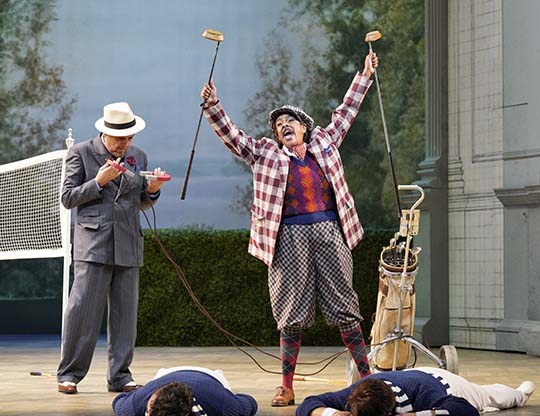
At the San Francisco Opera, there was a surprisingly successful production of Mozart's Cosi Fan Tutte, a long comic opera about two young lovers, Ferrando (tenor Ben Bliss) and Guglielmo (baritone John Brancy), who make a bet with the cynical Don Alfonso (veteran Italian bass Ferruccio Furlanetto) about their girlfriends' steadfastness and virtue. Spoiler alert: The lovers lose the wager. (Production photos by Cory Weaver.)
The victims of this cruel caper are the sisters Fiordiligi (Nicole Cabell) and Dorabella (Irene Roberts) who are wooed throughout the opera by their boyfriends in disguise, which basically consisted of large moustaches.
The ensemble meshed perfectly, dramatically and musically, with the achingly beautiful tenor of Ben Bliss a particular highlight. His big aria, Un aura amorosa, was as moving as any version I have ever heard.
The clever production design by Erhard Rom used the same American Colonial mansion set from 2019's The Marriage of Figaro, now updated to a country club in the 1930s, complete with swimming pool and a badminton court. Director Michael Cavanagh's staging was endlessly creative and funny, with the mood organically transforming from broad farce to serious drama, a tricky balancing act that is baked into the opera itself. The ending mirrored that of Messalina, an outwardly happy finale staged as an unhappy resolution, which worked brilliantly.
Nicole Heaton was also noteworthy as the maid Despina, here a waitress at the country club, who conspires with Don Alfonso in various ruses, including disguising herself as a doctor called in from the golf course. The conductor Henrik Nánási led the SF Opera Orchestra in a sparkling rendition of what might be Mozart's richest operatic score. Congratulations to everyone involved.
Sunday, November 21, 2021

Inferno in the Castro

The Italian Cultural Institute of San Francisco celebrated the 700th anniversary of Dante's death with a free screening of a famous 1911 silent film, L'Inferno at the Castro Theater.
This was the Institute's first live event since the pandemic began, and it was a pleasure hearing half the large audience chattering with each other in Italian, a language which sounds to me like everyone is singing.
A speaker from the Institute explained that we were seeing a newly restored print from Cineteca di Bologna of the first Italian feature film and the oldest silent feature that still exists. The title cards were in Italian so an onstage translator read them to us in Italian and quickly translated English in between the live music accompaniment by the Sascha Jacobsen Quintet.
I recently read Dante's The Divine Comedy for the first time, slowly, over the course of a year, and it proved to be as extraordinary as its reputation, especially in the Dorothy Sayers translation with its witty, informative notes. The first book in the trilogy is a journey by Dante and the Roman poet Virgil through Hell, which is pictured to be in the center of the earth. The second details a climbing expedition up Mount Purgatory, while the third zooms to the planets and outer space for Paradise. The mixture of allusions to classical mythology, Christian history, and contemporary events and personages is astonishing, combining all Western knowledge across time.
I have wanted to see this film since reading The City of Palaces, Michael Nava's magnificent 2014 novel set during the Mexican Revolution. One of its major characters is a sensitive, artistic boy who sneaks into a a back room where they are projecting L'Inferno which induces nightmares through the rest of his childhood.
The character is also disturbingly, erotically excited by the sight of hundreds of naked sinners, most of them wearing a thin loincloth over their genitals. In truth, I have never seen so much pubic hair in a film in my life.
The 70-minute movie is filled with wild special effects and the new print really is beautiful. If you'd like to check it out, click here for the full movie on YouTube.
The musical accompaniment by the Sascha Jacobsen Quintet (Javier Santiago, piano; Michele Walter, violin; Andy Lewis, percussion; Sheldon Brown, clarinet, and Sascha Jacobsen, bass, composer) was delightful, lively and adept at weaving in and out of the onstage narration. The only criticism is that it didn't match up in mood with the film, being a bit too jaunty while the images were unceasingly horrific until Dante and Virgil finally escaped Hell. "E quindi uscimmo a riveder le stelle. (And thence we came forth to see, once again, the stars.)"

Sunday, November 14, 2021

Joan Mitchell Retrospective at SFMOMA

A huge retrospective of the American painter Joan Mitchell (1925-1992) has opened at SFMOMA before traveling to Baltimore and Paris early next year. The entrance is adorned with an enlarged photo of Ms. Mitchell puffing away on a cigarette, rather like one of Joan Didion's author photos, which seems in poor taste since Ms. Mitchell's last decade was plagued with ill health while recovering from oral cancer surgery and she eventually died at age 67 from lung cancer.
In every other respect, her life seemed enviable. Born to an affluent family in Chicago, she moved to New York after World War Two and became one of the few successful women in the Boys Club of Abstract Expressionism in the 1950s, holding her own at the Cedar Tavern, an infamous artists' dive, and the studios of fellow artists such as Philip Guston, Franz Kline, and Willem de Kooning.
At the end of the 1950s, she moved to Paris, where she had begun a decades-long, tumultuous affair with the French-Canadian artist Jean-Paul Riopelle.
In 1967, she received an inheritance from her mother, and bought a house in Giverny, near Monet's final home, where she lived with 13 dogs and played hostess to a coterie of friends and young artists from all disciplines for the next three decades.
Just when you think the exhibit is over, yet another expansive room appears and the colorful squiggles on the large canvases become richer and somehow more delightful.
Of course, some people's mobile device addictions get in the way...
...but for those willing to surrender to the monumental paintings...
...it is easy to become a Joan Mitchell fan.
The exhibit will be at SFMOMA through the middle of January, and is very much worth checking out.