The San Francisco Silent Film Festival began at the Castro Theater in 1996 and over the last 30 years has blossomed into the largest silent film festival in the Americas. This year's five-day festival marked its return home after Another Planet Entertainment spent years and millions refurbishing the place and ripping out its tiered orchestra seating for a flat floor better suited to a stand-up music venue.
After much neighborhood pushback, a compromise was reached that included tiered temporary seating in the orchestra section with the balcony retaining the original movie seats. The new temporary seating downstairs has good sightlines but feels like stacked sports bleachers that make for human bottlenecks in every passageway. The seats only go halfway up someone's back, so some true devotees who would sit through five different films in a day were decamping to the balcony for posterior support. Still, it's a happy miracle that the theater has survived and is not only thriving but continues to work with film festivals.
Two of the most essential people at the festival are the British pianist Stephen Horne who accompanies films with a lyrical, quicksilver responsiveness to what's on the screen, and Artistic Director Anita Monga, one of the greatest film programmers in the world.
I started at the festival with a wild double bill, "erotic melodramas" from Denmark. 1910's The Abyss was the debut of 18-year-old Asta Nielsen as a piano teacher who runs off with a faithless circus dancer which does not end well for anyone. She became an instant global movie star on account of a five-minute "gaucho dance" with her tied-up lover that is one of the lewder things I've seen on film. (Click here for the YouTube excerpt.)
This was followed by 1917's The Clown, starring Valdemar Psilander, the biggest movie actor of early silent films. Officially, he had a heart attack and died at the age of 32, though he probably either drank himself to death or committed suicide by other means. The film was another story of a faithless wife whose lust sets the eventual tragedy in motion.
The next day brought two Hollywood comedies, starting with Clara Bow in the 1927 Hula. She plays a perky tomboy on Maui who sets her sights on handsome engineer Clive Brook. He's a hero with the least personal agency imaginable, between a socialite trying to woo him, a wife trying to get money out of him, and the indefatigable Clara Bow blowing up a mountain just to keep him around. The plot was utterly ridiculous but funny, and Stephen Horne's accompaniment was delightful.
The other comedy was 1926's The Caveman, with Marie Prevost and Matt Moore in a class-based reverse Pygmalion story set among the swells of Manhattan and the Irish slums of the lower East Side. The gender politics were a bit creepy throughout, but Marie Prevost's strength and charm mitigated some of it.
I missed the opening night showing of Queen Kelly, Gloria Swanson's unfinished 1929 film directed by Erich von Stroheim, but managed to catch her in The Humming Bird from 1924. It was a weird mixture of Parisian underworld capers, religiosity, and patriotism, and about one third of the movie has gone permanently missing.
My favorite movie of the festival was the 1930 Polish film, Janko the Musician, taken from an extremely depressing 19th century story about a holy innocent peasant child who has a sacred connection with music before being beaten and dying after he steals a violin. In this version, the tale has been Hollywoodized and thank the Holy Virgin Mary for that. The twelve-year-old Stefan Rogulski played the sacred child with such luminosity that the name Tadzio came to mind and his adult version is played by actor-violinist Witold Conti, a one-time lover of Polish composer Karol Szymanowski. The musical accompaniment was a mixture of musicaL numbers recorded after the silent film was finished, and a live trio of pianist/violinist Guenther Buchwald, Mas Koga on woodwinds, and Frank Bockius on percussion. They were magnificent.
My final film was Ernest Lubitsch's So This Is Paris, a 1926 infidelity farce based on an 1851 German play that was the source for Johann Strauss's opera Die Fledermaus. Among attempted racy dalliances between two couples, there is a famous Charleston dance sequence at the Parisian Artists' Ball that is completely berserk. (Click here for a YouTube clip.) It actually made you want to live in the 1920s.
Showing posts with label film. Show all posts
Thursday, May 14, 2026
Friday, March 27, 2026
Clara Bow as IT at The Castro
The San Francisco Silent Film Festival finally returned to its ancestral home at the Castro Theater last Sunday with a showing of the 1927 movie IT.
The huge theater was sold out and the line started forming along the sidewalk two hours before the screening.
There were many objections to Another Planet Entertainment transforming the 1922 Spanish Baroque masterpiece by architect Timothy Pflueger from a seated movie theater to a live pop concert hall, but the multi-year, $41 million makeover has turned out well. The compromise between temporary tiered seating for film showings and a flat dance floor for concerts has become a happy surprise.
Among the many improvements, the old basement bathrooms have now become gender-free and have plenty of stalls so the women's restroom line no longer stretches forever.
The real wonder is the interior restoration, an obvious labor of love, where decades of grime and cigarette smoke were scraped away and the brown ceiling has returned to its original red color with all its baroque illustrations gleaming.
IT was an entertaining bit of fluff comedy where Clara Bow as a shopgirl sets her sights on snagging the handsome young owner of the department store where she works.
Bow plays the personification of the 1920s flapper "IT" Girl who has ineffable sex appeal that can slay anyone, including the handsome Antonio Moreno, a Spaniard who was one of the first Latin lovers of American silent films.
The film was accompanied by a beefed-up Mont Alto Motion Picture Orchestra, a music ensemble from Colorado that specializes in silent movies.
They will also be accompanying films, along with a roster of other musical artists, at the upcoming San Francisco Silent Film Festival, which will be returning to the Castro from May 6 to 10. There's no place like home.
The huge theater was sold out and the line started forming along the sidewalk two hours before the screening.
There were many objections to Another Planet Entertainment transforming the 1922 Spanish Baroque masterpiece by architect Timothy Pflueger from a seated movie theater to a live pop concert hall, but the multi-year, $41 million makeover has turned out well. The compromise between temporary tiered seating for film showings and a flat dance floor for concerts has become a happy surprise.
Among the many improvements, the old basement bathrooms have now become gender-free and have plenty of stalls so the women's restroom line no longer stretches forever.
The real wonder is the interior restoration, an obvious labor of love, where decades of grime and cigarette smoke were scraped away and the brown ceiling has returned to its original red color with all its baroque illustrations gleaming.
IT was an entertaining bit of fluff comedy where Clara Bow as a shopgirl sets her sights on snagging the handsome young owner of the department store where she works.
Bow plays the personification of the 1920s flapper "IT" Girl who has ineffable sex appeal that can slay anyone, including the handsome Antonio Moreno, a Spaniard who was one of the first Latin lovers of American silent films.
The film was accompanied by a beefed-up Mont Alto Motion Picture Orchestra, a music ensemble from Colorado that specializes in silent movies.
They will also be accompanying films, along with a roster of other musical artists, at the upcoming San Francisco Silent Film Festival, which will be returning to the Castro from May 6 to 10. There's no place like home.
Friday, May 30, 2025
Yuan Goang-Ming: Everyday War
The 60-year-old Taiwanese video artist Yuan Goang-Ming is currently having his first solo exhibition in the U.S. at the Asian Art Museum.
His global reputation took a giant leap at last year's Venice Biennale where his Everyday War installation at the Taiwan pavilion was reportedly a festival highlight. The Venice show was curated by Abby Chen, who is currently the Head of Contemporary Art at San Francisco's Asian Art Museum, and brought the exhibit here, adding a few additional works by the artist. (For an interesting video of the Venice Biennale exhibit that includes interviews with Yuan, Chen, and lots of fancy art fair people sipping glasses of wine, click here.)
Although there are only about 9 works in the exhibit, they are spread out across the huge expanse of the Akiko Yamazaki and Jerry Yang Pavilion, which usually hosts large traveling exhibits. There is also comfortable furniture on which to sit and actually watch the videos that range from about 5 to 15 minutes. Plus, unlike Venice, there are no crowds, which is a luxury.
The videos are trance-like with the camera never panning to the right or left, only forward and backwards, both visually and with time. There is a serenity to them even when they are depicting empty major streets in Taipei during an annual nuclear disaster drill or a bedroom being destroyed in slow motion by gunshots and small explosions (I hope the goldfish survived).
I saw this exhibit briefly when it first opened in April and found it unpleasantly disquieting, but it was more compelling on a second viewing, especially after experiencing the sonic waves from a huge bomb going off in peaceful Palm Springs a few weeks ago.
Speaking of which, beware the dining room table situated in front of a screen featuring Google Street View gone amok. The table is scary.
While leaving I noticed a group of young people, a collective calling themselves Dream State, setting up installations throughout the museum for a "takeover" of the institution this weekend. The group was founded by Spencer Tsang who is pictured above, and the performance schedule looks like fun. Sunday is free admission to the museum, so check it out. Click here for more information on the museum's website.
His global reputation took a giant leap at last year's Venice Biennale where his Everyday War installation at the Taiwan pavilion was reportedly a festival highlight. The Venice show was curated by Abby Chen, who is currently the Head of Contemporary Art at San Francisco's Asian Art Museum, and brought the exhibit here, adding a few additional works by the artist. (For an interesting video of the Venice Biennale exhibit that includes interviews with Yuan, Chen, and lots of fancy art fair people sipping glasses of wine, click here.)
Although there are only about 9 works in the exhibit, they are spread out across the huge expanse of the Akiko Yamazaki and Jerry Yang Pavilion, which usually hosts large traveling exhibits. There is also comfortable furniture on which to sit and actually watch the videos that range from about 5 to 15 minutes. Plus, unlike Venice, there are no crowds, which is a luxury.
The videos are trance-like with the camera never panning to the right or left, only forward and backwards, both visually and with time. There is a serenity to them even when they are depicting empty major streets in Taipei during an annual nuclear disaster drill or a bedroom being destroyed in slow motion by gunshots and small explosions (I hope the goldfish survived).
I saw this exhibit briefly when it first opened in April and found it unpleasantly disquieting, but it was more compelling on a second viewing, especially after experiencing the sonic waves from a huge bomb going off in peaceful Palm Springs a few weeks ago.
Speaking of which, beware the dining room table situated in front of a screen featuring Google Street View gone amok. The table is scary.
While leaving I noticed a group of young people, a collective calling themselves Dream State, setting up installations throughout the museum for a "takeover" of the institution this weekend. The group was founded by Spencer Tsang who is pictured above, and the performance schedule looks like fun. Sunday is free admission to the museum, so check it out. Click here for more information on the museum's website.
Thursday, March 20, 2025
The Great Yes, The Great No
The Great Yes, The Great No, William Kentridge's new multimedia mixture of actors, dancers, singers, instrumentalists, animated projections, films, masks, drawings and stagecraft, was presented by Cal Performances at UC Berkeley's Zellerbach Hall last weekend. (All production photos are by Monika Rittershaus.)
The loose, wandering narrative depicts a real-life surreal Atlantic Ocean voyage in 1941 from Marseille, France to the colonial Caribbean island of Martinique, with refugees fleeing the Nazis and the collaborationist government of Vichy France. For good measure, other historical figures joined the transatlantic voyage, with everyone from Frantz Fanon to Josephine Bonaparte making appearances. The major presiding spirit was the French Surrealist poet Suzanne Césaire (embodied here by Nancy Nkusi reciting her poetry) and her husband Aimé Césaire who had taken an earlier voyage back to their native island.
There was a panel discussion before Friday night's premiere with the South African artist William Kentridge who conceived and directed the two-hour spectacle with a small army of collaborators. He spoke of his influences, ranging from a Mayakovsky play that he'd forgotten and unconsciously reproduced to an a capella lament he heard at a South African funeral that struck him deeply.
There were so many unfamiliar references and digressions that I found it impossible to make much sense of the theatrical work, but it did not matter because there was so much to absorb and enjoy.
A few of my favorite things included the flat, black-and-white masks that were miraculously enlivened by the dancers Thulani Chauke and Teresa Phuti Mojela. In the photo above, they are twin representations of the Surrealist poet Andre Breton, who was actually on this voyage of the cargo ship Capitaine Paul-Lemerle. My favorite of the cartoonish historical figures come to life were Diego Rivera dancing daintily while Frida Kahlo swings a sledge hammer next to him, an apter symbol of their respective impact than is usually offered onstage.
I also loved the musical backbone of the evening, a seven-woman chorus with music composed by Nhlanhla Mahlangu, along with the animated supertitles that were wittily integrated into the extraordinary animated projections of archival photos, Kentridge's drawings, and surrealist films.
The entire cast was superb without exception.
A quartet of instrumentalists played incidental and accompanying music onstage, with Music Director and percussionist Tlale Makhene brilliantly driving the score along.
The narrative was not only about the transatlantic refugees from World War II France, but the underlying history of transatlantic voyages from Africa to the colonial sugar slave plantations of Martinique. Though not explicitly underlined, the parallels between the present-day fascist takeover of the United States and its own history of slave plantations were everywhere.
Cal Performances was one of the many commissioners of The Great Yes, The Great No, and it felt like a rare honor to experience this show on its worldwide tour.
The loose, wandering narrative depicts a real-life surreal Atlantic Ocean voyage in 1941 from Marseille, France to the colonial Caribbean island of Martinique, with refugees fleeing the Nazis and the collaborationist government of Vichy France. For good measure, other historical figures joined the transatlantic voyage, with everyone from Frantz Fanon to Josephine Bonaparte making appearances. The major presiding spirit was the French Surrealist poet Suzanne Césaire (embodied here by Nancy Nkusi reciting her poetry) and her husband Aimé Césaire who had taken an earlier voyage back to their native island.
There was a panel discussion before Friday night's premiere with the South African artist William Kentridge who conceived and directed the two-hour spectacle with a small army of collaborators. He spoke of his influences, ranging from a Mayakovsky play that he'd forgotten and unconsciously reproduced to an a capella lament he heard at a South African funeral that struck him deeply.
There were so many unfamiliar references and digressions that I found it impossible to make much sense of the theatrical work, but it did not matter because there was so much to absorb and enjoy.
A few of my favorite things included the flat, black-and-white masks that were miraculously enlivened by the dancers Thulani Chauke and Teresa Phuti Mojela. In the photo above, they are twin representations of the Surrealist poet Andre Breton, who was actually on this voyage of the cargo ship Capitaine Paul-Lemerle. My favorite of the cartoonish historical figures come to life were Diego Rivera dancing daintily while Frida Kahlo swings a sledge hammer next to him, an apter symbol of their respective impact than is usually offered onstage.
I also loved the musical backbone of the evening, a seven-woman chorus with music composed by Nhlanhla Mahlangu, along with the animated supertitles that were wittily integrated into the extraordinary animated projections of archival photos, Kentridge's drawings, and surrealist films.
The entire cast was superb without exception.
A quartet of instrumentalists played incidental and accompanying music onstage, with Music Director and percussionist Tlale Makhene brilliantly driving the score along.
The narrative was not only about the transatlantic refugees from World War II France, but the underlying history of transatlantic voyages from Africa to the colonial sugar slave plantations of Martinique. Though not explicitly underlined, the parallels between the present-day fascist takeover of the United States and its own history of slave plantations were everywhere.
Cal Performances was one of the many commissioners of The Great Yes, The Great No, and it felt like a rare honor to experience this show on its worldwide tour.
Tuesday, April 30, 2024
Non-Cinematic Walton and Prokofiev at the SF Symphony
Last weekend's San Francisco Symphony concerts were marketed as "cinematic inspirations" which turned out not to be the case at all. Although Shostakovich, Walton, and Prokofiev all composed memorable film scores during their careers, the only one that was cinematic was a 1938 Shostakovich Funeral March for the 1938 Soviet movie The Great Citizen, heavily edited by Stalin himself. It would have been interesting to have the actual film clip showing with the 8-minute piece but that didn't happen. Shostakovich's musical skill was evident in the performance but it did seem odd to start a concert off with a funeral march.
This was followed by the British composer William Walton's 1928 Viola Concerto which was a delightful surprise. Walton (1902-1983) is best known now for his film scores to Olivier's cinematic Shakespeare adaptations (Henry V, Richard III, and Hamlet) but during the 1920's he was considered a promising modernist with Facade, his success de scandale with Edith Sitwell on a megaphone, the over-the-top oratorio Belshazzar's Feast, and this viola concerto which was premiered by the violist and composer Paul Hindemith. Walton's subsequent career was less successful, with critical consensus proclaiming him dull and old-fashioned for the next 40 years. (All production photos are by Stefan Cohen.)
In any case, this early viola concerto is lively and piquant from beginning to end, and SF Symphony principal violist Jonathan Vinocour gave an exquisite performance. Vinocour still looks like the handsome, slightly nerdy chemistry major that he once was, and he's been one of my favorite musicians in the orchestra since his arrival in 2009. His solo moments during full orchestral concerts are always a highlight for their tonal beauty and exceptional musicianship, and it was a real treat to hear him as a concerto soloist.
Sergei Prokofiev also composed memorable scores for films like Alexander Nevsky, Ivan the Terrible, and Lieutenant Kijé, but his 1928 Symphony No. 3 has nothing to do with film but is a reworking of the final act of his unproduced opera The Fiery Angel. Spanish guest conductor Gustavo Gimeno did a fine job with the entire concert, but the Prokofiev symphony did not fare so well.
The opera itself wasn't produced until 1955 in Italy, and didn't appear until the 1990s in Russia, where a famous production directed by David Freeman toured the world, eventually appearing at the San Francisco Opera. (You can actually see a filmed version of the St. Petersburg production on YouTube, click here.) The story itself is based on a satirical Russian symbolist novel and in this operatic adaptation it's totally bonkers. It is in five short acts, culminating in an insane final act set in a medieval convent filled with nuns possessed by demons confronting the Grand Inquisitor. It's like the Ken Russell film The Devils, except with great music.
The problem with the symphony is it starts at full voltage and from there really has nowhere to go, unlike the opera which is essentially a chamber piece until the 50+ nuns appear for the insane finale. In other words, the four-movement symphony just sounded very loud and incoherent, and made me want to hear the opera instead, either in concert or on the stage.
This was followed by the British composer William Walton's 1928 Viola Concerto which was a delightful surprise. Walton (1902-1983) is best known now for his film scores to Olivier's cinematic Shakespeare adaptations (Henry V, Richard III, and Hamlet) but during the 1920's he was considered a promising modernist with Facade, his success de scandale with Edith Sitwell on a megaphone, the over-the-top oratorio Belshazzar's Feast, and this viola concerto which was premiered by the violist and composer Paul Hindemith. Walton's subsequent career was less successful, with critical consensus proclaiming him dull and old-fashioned for the next 40 years. (All production photos are by Stefan Cohen.)
In any case, this early viola concerto is lively and piquant from beginning to end, and SF Symphony principal violist Jonathan Vinocour gave an exquisite performance. Vinocour still looks like the handsome, slightly nerdy chemistry major that he once was, and he's been one of my favorite musicians in the orchestra since his arrival in 2009. His solo moments during full orchestral concerts are always a highlight for their tonal beauty and exceptional musicianship, and it was a real treat to hear him as a concerto soloist.
Sergei Prokofiev also composed memorable scores for films like Alexander Nevsky, Ivan the Terrible, and Lieutenant Kijé, but his 1928 Symphony No. 3 has nothing to do with film but is a reworking of the final act of his unproduced opera The Fiery Angel. Spanish guest conductor Gustavo Gimeno did a fine job with the entire concert, but the Prokofiev symphony did not fare so well.
The opera itself wasn't produced until 1955 in Italy, and didn't appear until the 1990s in Russia, where a famous production directed by David Freeman toured the world, eventually appearing at the San Francisco Opera. (You can actually see a filmed version of the St. Petersburg production on YouTube, click here.) The story itself is based on a satirical Russian symbolist novel and in this operatic adaptation it's totally bonkers. It is in five short acts, culminating in an insane final act set in a medieval convent filled with nuns possessed by demons confronting the Grand Inquisitor. It's like the Ken Russell film The Devils, except with great music.
The problem with the symphony is it starts at full voltage and from there really has nowhere to go, unlike the opera which is essentially a chamber piece until the 50+ nuns appear for the insane finale. In other words, the four-movement symphony just sounded very loud and incoherent, and made me want to hear the opera instead, either in concert or on the stage.
Tuesday, April 16, 2024
2024 SF Silent Film Festival
The San Francisco Silent Film Festival unspooled 20+ films last week at the Palace of Fine Arts. The festival's usual home, the Castro Theatre, is currently being destroyed as a movie palace by Another Planet Entertainment while they repurpose that building for a concert venue.
The huge hall surrounding the Palace of Fine Arts has been used over the decades for everything from Parks storage to tennis courts to a telephone book distribution center. The theater was added to the structure in 1970.
Of all the arts, movies are the most direct at transporting a viewer through time, and silent films doubly so. This makes the experience of watching old-time movies in a theater with an audience and live musicians feel paradoxically modern. !00+ years ago, movies were in their infancy, and audiences were not able to go back in time via cinema. We are in a new historical moment.
On Thursday the day began with a series of lectures and clips in a popular annual program called Amazing Tales from the Archives. A dry, witty Bryony Dixon, silent film curator at the British Film Institute, introduced a series of clips from travel shorts of the 1920s called Travelaughs that featured the young Michael Powell, future director, as a goofball nature lover. This was followed by the academic Denise Khor, above, introducing the 1914 The Oath of the Sword, a 30-minute variant on Madame Butterfly made by an all Japanese-American cast and production company.
All the clips were accompanied by Stephen Horne, my favorite silent film composer/improviser. He plays piano with the occasional additions of a flute or accordion, and he somehow manages to inhabit the interior of characters in a penetrating, often melancholic fashion.
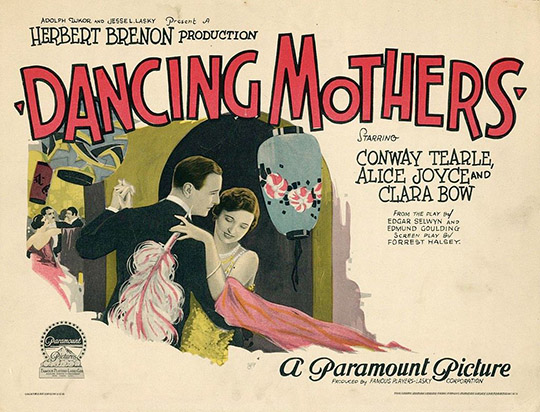
The afternoon movie was a Clara Bow double-bill, starting with a 1923 short called The Pill Pounder. Thought to be forever lost, a partial print was recently discovered at a film distribution parking lot sale in Omaha, Nebraska. The feature was the 1926 Dancing Mothers, which was a direct hit of time travel to the Prohibition Jazz Age era among New York socialites. The melodramatic plot surprisingly resolved as a riff on A Doll's House, except drenched in sex, cigarettes, and booze.
The Palace of Fine Arts is a slog to get to via public transportation, but there are compensations, such as a series of young women dressed in fabulous outfits posing all over the Palace on a cold, rainy Saturday night.
That's when we returned to see a Buster Keaton double bill accompanied by the Mont Alto Motion Picture Orchestra.
The main feature was the 1934 Sherlock, Jr., but the real revelation, and the funnier film, was the 1920 short One Week. When the grotesque, assemble-it-yourself home starts rotating during a storm, it's one of the most inspired Keaton sequences ever.
I could only go out twice because I had to mostly stay in bed last week for boring reasons, but was able to read the 120-page program which is an unusually beautiful and brilliant collection of essays and photos by writers and historians from around the world.
The huge hall surrounding the Palace of Fine Arts has been used over the decades for everything from Parks storage to tennis courts to a telephone book distribution center. The theater was added to the structure in 1970.
Of all the arts, movies are the most direct at transporting a viewer through time, and silent films doubly so. This makes the experience of watching old-time movies in a theater with an audience and live musicians feel paradoxically modern. !00+ years ago, movies were in their infancy, and audiences were not able to go back in time via cinema. We are in a new historical moment.
On Thursday the day began with a series of lectures and clips in a popular annual program called Amazing Tales from the Archives. A dry, witty Bryony Dixon, silent film curator at the British Film Institute, introduced a series of clips from travel shorts of the 1920s called Travelaughs that featured the young Michael Powell, future director, as a goofball nature lover. This was followed by the academic Denise Khor, above, introducing the 1914 The Oath of the Sword, a 30-minute variant on Madame Butterfly made by an all Japanese-American cast and production company.
All the clips were accompanied by Stephen Horne, my favorite silent film composer/improviser. He plays piano with the occasional additions of a flute or accordion, and he somehow manages to inhabit the interior of characters in a penetrating, often melancholic fashion.
The afternoon movie was a Clara Bow double-bill, starting with a 1923 short called The Pill Pounder. Thought to be forever lost, a partial print was recently discovered at a film distribution parking lot sale in Omaha, Nebraska. The feature was the 1926 Dancing Mothers, which was a direct hit of time travel to the Prohibition Jazz Age era among New York socialites. The melodramatic plot surprisingly resolved as a riff on A Doll's House, except drenched in sex, cigarettes, and booze.
The Palace of Fine Arts is a slog to get to via public transportation, but there are compensations, such as a series of young women dressed in fabulous outfits posing all over the Palace on a cold, rainy Saturday night.
That's when we returned to see a Buster Keaton double bill accompanied by the Mont Alto Motion Picture Orchestra.
The main feature was the 1934 Sherlock, Jr., but the real revelation, and the funnier film, was the 1920 short One Week. When the grotesque, assemble-it-yourself home starts rotating during a storm, it's one of the most inspired Keaton sequences ever.
I could only go out twice because I had to mostly stay in bed last week for boring reasons, but was able to read the 120-page program which is an unusually beautiful and brilliant collection of essays and photos by writers and historians from around the world.
Subscribe to:
Posts (Atom)