Another dollop from the seemingly inexhaustible well of Beatlemania has arrived at the deYoung Museum in San Francisco for the next four months.
In 2020 Paul McCartney rediscovered old pictures he had taken as an amateur art photographer for three months that spanned December 1963 through February 1964.
The settings are Liverpool, Paris, New York, and Miami just when their international fame was exploding, much of which was featured in the 1964 Richard Lester movie A Hard Day's Night.
The photos are often prankish...
...when the quartet were in their early 20s.
It is also a reminder of the delicate beauty of John Lennon at that age.
There is a brief video of their epochal appearance on the weird old variety show hosted by Ed Sullivan...
...complete with shots of the screaming adolescent girls in the audience, a bizarre 20th century version of Euripedes's The Bacchae.
The exhibit is aptly titled "Eyes of the Storm" as the observed watch the observers...
...including mobs of fans rushing down a New York street.
The most poignant character among the photos is Brian Epstein, their closeted homosexual manager who died at age 32 in 1967 after getting sloppy with too many strong pills and liquor a la Valley of the Dolls.
The only color photos are from a Miami resort where they taped another appearance for the Ed Sullivan Show.
If you have a membership to the Fine Arts Museums, the exhibit is well worth a visit. Otherwise, the hefty single ticket price is probably not worth it unless you are a Beatlemaniac yourself.
Showing posts with label journalism. Show all posts
Saturday, March 08, 2025
Monday, July 11, 2022
The USS Potomac on the Fourth of July
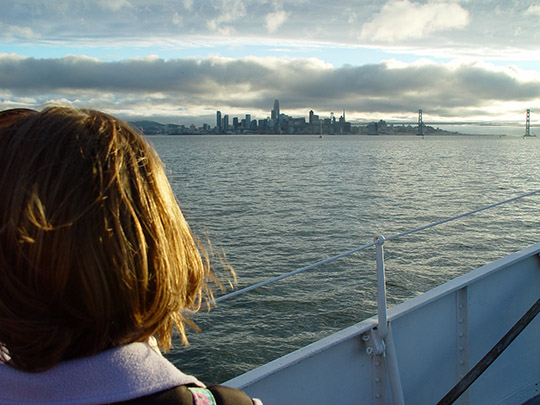
In most of the United States, Fourth of July is as much a pagan celebration of midsummer as it is a patriotic festival. In San Francisco it's usually a nothingburger, possibly because it marks the midfog season. Over the years I visited Midwestern and Eastern cities on the 4th and loved the heat and communal barbeques and fireworks (Chicago's Lake Michigan and Boston's Charles River tied for lights-and-music extravagance). This year I impulsively booked a 4th of July Cruise on the USS Potomac around San Francisco Bay, and the experience was a happy surprise. (Photo above is of a recently retired Chicago dad who was visiting his East Bay daughter.)
The USS Potomac was designed as a Prohibition-era patrol boat for the U.S. Coast Guard. Christened Electra in 1934, President Franklin Delano Roosevelt had it transferred to the U.S. Navy and remodeled as his presidential yacht for relaxation, discreet political business, and entertaining. "How did this boat end up in Jack London Square in Oakland?" I asked the new Executive Director of the nonprofit in charge. "It's sort of a crazy story. Let me give you the short version..." he began.
There are a number of histories on the internet of what happened to the USS Potomac after FDR's death, but the best account is by Sam Gnerr in a 2020 article for the Redondo Beach Daily Breeze: "After FDR’s death in 1945, the Potomac was returned to the Coast Guard, which then decommissioned it in May 1946. For the next 14 years, the state of Maryland used the boat as a fisheries industry enforcement vessel along its coastal areas. In 1960, the state of Maryland sold the Potomac to a private owner. The buyer moved it to the Caribbean, where it was used as a ship ferrying passengers between Puerto Rico and the Virgin Islands.The deteriorating Potomac’s next owner, the Hydro-Capital Co., acquired the ship in 1962. Its plan included renovating the ship at a cost of $500,000, then mounting it in the newly constructed King Harbor in Redondo Beach as a tourist attraction."
There were weather problems, harbor problems, insurance problems, lack of maintenance problems, and somehow Elvis Presley's mother got involved and called her son telling him he needed to buy the USS Potomac. He did so and then donated it to Danny Thomas and the St. Jude's Hospital for Children charity, which auctioned it off. After a number of different owners, it was purchased by sleazy Stockton bailbondsman Aubrey Phillips in 1971, who parked it at San Francisco's Pier 26 as a tourist attraction that nobody visited. I vaguely remember seeing it on the waterfront during that decade and it always looked dodgy.
Sam Gnerr continues: "In 1980, the Potomac, adorned with a banner for a phony, nonexistent children’s charity — was raided by U.S. Customs agents, who had seized it after determining it had been acting as a headquarters for a marijuana dealing ring. The ship reached its lowest point when the feds towed the boat to Treasure Island, in San Francisco Bay, where it sank unceremoniously six months later, probably due to a leaky hull."
A 2017 SF Chronicle article by Bill Van Niekerken continues the story: “It looks like she died of old age,” said Lt. Cmdr. G. Ray Olsen. “Her hull is corroded and very rusty.” “I’d scrap her — the whole bottom’s rotten,” added Tim Hinkster, a Pacific DryDock employee. The Coast Guard wouldn’t be deterred, and raised the ship out of San Francisco Bay and again put it up for auction. No luck. Another try, and a drop in price, produced a taker, Walter Abernathy, a Port of Oakland executive. He was also the only suitor, and he bought the Potomac with a minimum bid of $15,000. Abernathy took some razzing, with his purchase called Wally’s Folly, but he remained optimistic. “I figured anything that attracted that much attention had to be valuable,” he said. “So I thought, ‘Let’s do it.’”
The article ends with: "According to Chronicle reporter Sandy Zane, the restoration of the presidential yacht cost $5 million. Half the money came from a federal matching grant, and the rest was raised through private channels, in large part due to Roosevelt’s son James and his grandson Michael, who lived in Berkeley.."
I looked at the Executive Director's nametag closer after his history recitation and it read Ford Roosevelt. "Any relation?" I asked. "Grandson," he replied. "I used to run an educational non-profit for underprivileged youth in Los Angeles for a few decades and they ran out of money. So I then saw the posting for Non-Profit Executive Director for the USS Potomac last fall, and I moved here with my wife to Alameda last November. And it costs fifty cents with a Senior Clipper Card to get to work."
Hanging out with an honest to goodness Roosevelt link while cruising on this presidential yacht was wonderful enough, but the ship itself was magical. You could feel all of the vessel's history from the highest to lowest, and also the love that has gone into its restoration.
USS Potomac cruises have a 120 passenger maximum which meant the evening was not crowded and fellow passengers were an odd, delightful mixture.
The $125 price included "snacks and beverages," which consisted of water and good wine and a snack pack that sent one into instant 6th grade field trip nostalgia.
There are two-hour cruises four times a month, on Thursday and Saturday mornings, which are a bit pricey at $75, but it is worth every penny (click here for the schedule). I was afraid we would be subjected to a loudspeaker historical narration, but instead the volunteer docents will give personal tours or just allow you to sip wine and absorb the vessel's atmosphere while looking at incredible views. This may be the best tourist activity in the San Francisco Bay Area.
Going around the Golden Gate Bridge on the Fourth during a fog storm was exciting and spooky, but the fireworks on the bay were absurd, explosions followed by colored fog. The Gay Pride Parade recently projected rainbow lasers up Market Street over a long weekend and its refractions in the ever-present fog was beautiful. My advice to whoever is sponsoring the San Francisco Fourth of July celebrations is to commission a laser light artist to create a piece specifically designed to create impressionistic laser shows in the fog. It could be a double play of ecologically forward-thinking (no explosions and animals harmed) plus extraordinary artistry.
My advice for the USS Potomac is to consider ditching San Francisco and having a Fourth of July cruise next year to the South Bay where Oakland, Fremont, Foster City and other Bay Area cities have local fireworks shows that can actually be seen. It would also be a specific acknowledgement of the East Bay where the USS Potomac has found a loving home.
The USS Potomac was designed as a Prohibition-era patrol boat for the U.S. Coast Guard. Christened Electra in 1934, President Franklin Delano Roosevelt had it transferred to the U.S. Navy and remodeled as his presidential yacht for relaxation, discreet political business, and entertaining. "How did this boat end up in Jack London Square in Oakland?" I asked the new Executive Director of the nonprofit in charge. "It's sort of a crazy story. Let me give you the short version..." he began.
There are a number of histories on the internet of what happened to the USS Potomac after FDR's death, but the best account is by Sam Gnerr in a 2020 article for the Redondo Beach Daily Breeze: "After FDR’s death in 1945, the Potomac was returned to the Coast Guard, which then decommissioned it in May 1946. For the next 14 years, the state of Maryland used the boat as a fisheries industry enforcement vessel along its coastal areas. In 1960, the state of Maryland sold the Potomac to a private owner. The buyer moved it to the Caribbean, where it was used as a ship ferrying passengers between Puerto Rico and the Virgin Islands.The deteriorating Potomac’s next owner, the Hydro-Capital Co., acquired the ship in 1962. Its plan included renovating the ship at a cost of $500,000, then mounting it in the newly constructed King Harbor in Redondo Beach as a tourist attraction."
There were weather problems, harbor problems, insurance problems, lack of maintenance problems, and somehow Elvis Presley's mother got involved and called her son telling him he needed to buy the USS Potomac. He did so and then donated it to Danny Thomas and the St. Jude's Hospital for Children charity, which auctioned it off. After a number of different owners, it was purchased by sleazy Stockton bailbondsman Aubrey Phillips in 1971, who parked it at San Francisco's Pier 26 as a tourist attraction that nobody visited. I vaguely remember seeing it on the waterfront during that decade and it always looked dodgy.
Sam Gnerr continues: "In 1980, the Potomac, adorned with a banner for a phony, nonexistent children’s charity — was raided by U.S. Customs agents, who had seized it after determining it had been acting as a headquarters for a marijuana dealing ring. The ship reached its lowest point when the feds towed the boat to Treasure Island, in San Francisco Bay, where it sank unceremoniously six months later, probably due to a leaky hull."
A 2017 SF Chronicle article by Bill Van Niekerken continues the story: “It looks like she died of old age,” said Lt. Cmdr. G. Ray Olsen. “Her hull is corroded and very rusty.” “I’d scrap her — the whole bottom’s rotten,” added Tim Hinkster, a Pacific DryDock employee. The Coast Guard wouldn’t be deterred, and raised the ship out of San Francisco Bay and again put it up for auction. No luck. Another try, and a drop in price, produced a taker, Walter Abernathy, a Port of Oakland executive. He was also the only suitor, and he bought the Potomac with a minimum bid of $15,000. Abernathy took some razzing, with his purchase called Wally’s Folly, but he remained optimistic. “I figured anything that attracted that much attention had to be valuable,” he said. “So I thought, ‘Let’s do it.’”
The article ends with: "According to Chronicle reporter Sandy Zane, the restoration of the presidential yacht cost $5 million. Half the money came from a federal matching grant, and the rest was raised through private channels, in large part due to Roosevelt’s son James and his grandson Michael, who lived in Berkeley.."
I looked at the Executive Director's nametag closer after his history recitation and it read Ford Roosevelt. "Any relation?" I asked. "Grandson," he replied. "I used to run an educational non-profit for underprivileged youth in Los Angeles for a few decades and they ran out of money. So I then saw the posting for Non-Profit Executive Director for the USS Potomac last fall, and I moved here with my wife to Alameda last November. And it costs fifty cents with a Senior Clipper Card to get to work."
Hanging out with an honest to goodness Roosevelt link while cruising on this presidential yacht was wonderful enough, but the ship itself was magical. You could feel all of the vessel's history from the highest to lowest, and also the love that has gone into its restoration.
USS Potomac cruises have a 120 passenger maximum which meant the evening was not crowded and fellow passengers were an odd, delightful mixture.
The $125 price included "snacks and beverages," which consisted of water and good wine and a snack pack that sent one into instant 6th grade field trip nostalgia.
There are two-hour cruises four times a month, on Thursday and Saturday mornings, which are a bit pricey at $75, but it is worth every penny (click here for the schedule). I was afraid we would be subjected to a loudspeaker historical narration, but instead the volunteer docents will give personal tours or just allow you to sip wine and absorb the vessel's atmosphere while looking at incredible views. This may be the best tourist activity in the San Francisco Bay Area.
Going around the Golden Gate Bridge on the Fourth during a fog storm was exciting and spooky, but the fireworks on the bay were absurd, explosions followed by colored fog. The Gay Pride Parade recently projected rainbow lasers up Market Street over a long weekend and its refractions in the ever-present fog was beautiful. My advice to whoever is sponsoring the San Francisco Fourth of July celebrations is to commission a laser light artist to create a piece specifically designed to create impressionistic laser shows in the fog. It could be a double play of ecologically forward-thinking (no explosions and animals harmed) plus extraordinary artistry.
My advice for the USS Potomac is to consider ditching San Francisco and having a Fourth of July cruise next year to the South Bay where Oakland, Fremont, Foster City and other Bay Area cities have local fireworks shows that can actually be seen. It would also be a specific acknowledgement of the East Bay where the USS Potomac has found a loving home.
Wednesday, December 25, 2019
Eun Sun Kim and the Adler Fellows
An email invitation to attend an onstage Major Announcement was sent out by the San Francisco Opera earlier this month.
The most viable guess for the drama was that the company was announcing a new Music Director. Lisa Hirsch (above right) speculated at the Iron Tongue of Midnight blog who the top four contenders might be (either Eun Sun Kim, James Gaffigan, Christopher Franklin, or Henrik Nánási), and one of her hunches was correct.
The 39-year-old Eun Sun Kim, who conducted Dvorak's Rusalka in her company debut last summer, was chosen, a decision ecstatically received by many in the orchestra, chorus, backstage crew, and management, not to mention the conductor herself.
San Francisco Opera didn't have a Music Director for its first sixty years, relying on guest conductors with overall music direction dictated by the company's two General Directors: founder Gaetano Merola (1923-1953), followed by Kurt Herbert Adler (1953-1981), with both conducting the occasional production. Merola died before I was born, but I did hear Adler conduct a number of times in the 1970s, sluggishly and with an authoritarian streak towards performers that became infamous. The Music Director position was created in 1985, filled by Sir John Pritchard, who was at the end of a long, distinguished career at Covent Garden and Glyndebourne. He seemed bored by most of his assignments at the SF Opera, with a few notable exceptions such as an electrifying Lady Macbeth of Mtsensk with Josephine Barstow, and he died in 1989 at the relatively early age of 68. The young, energetic and fabulously talented Donald Runnicles took the helm in 1992 for the next 17 years and the overall musical quality of both orchestra and chorus rose inestimably, while Runnicles' own conducting abilities seemed to grow with each year. His successor, Nicola Luisotti (2009-2018), was hired on the basis of a sensational conducting job on a production of Verdi's La Forza del Destino, but just about everything after that felt like a slide downhill or inappropriate for his particular musical affinities.
The new General Director Matthew Shilvock made the announcement of Kim's appointment and filled in her biography briefly. She was born in 1980 in Seoul, South Korea where she studied composition at the Yonsei University. A professor was so impressed with her coaching a student production of La Boheme that he encouraged her to focus on conducting. She continued her studies in Germany, with a doctorate from the University of Music in Stuttgart. Her apprenticeship in various European opera houses began at Madrid's Teatro Real in 2008, and continued in houses throughout Germany.
In an onstage interview, she recounted the difficulty of her U.S. debut with a production of La Traviata at the Houston Grand Opera weeks after Hurricane Harvey flooded the city in 2017. The production moved to an improvised pop-up theater in the George Brown Convention Center and Kim conducted the orchestra from behind the performers on a circular stage, rather like SF Opera's productions at Bill Graham during the opera house's 1996 earthquake retrofit. The experience went well enough that the company immediately named her Principal Guest Conductor.
During the audience interview portion, I asked her if she had any particular affinity for certain composers, and she declined to name any favorites. A few other questioners asked a variation on the same question and the response was the same, basically that whoever she is studying and conducting at the moment is her favorite.
The following evening, Shilvock introduced Kim to the audience at the annual Adler Fellows The Future Is Now concert, which she had long been scheduled to conduct. This grab-bag of scenas and arias seemed a good way to hear how she navigated composers from Handel to Bernstein.
Unfortunately, she was faced with the same dilemma as in Houston, conducting the large SF Opera orchestra on the small Herbst Theatre stage with singers at her back, which necessitated a lot of neck-twisting and contortions to keep everyone together. (Production photos are by Kristen Loken.)
Within these constraints, she did a remarkable job of conducting, starting off with the best live rendition of Bernstein's Candide Overture that I have ever heard, making it sound more seriously soulful than satirical hijinks. Her Verdi was very good, she doesn't get Mozart at all (it's surprising how many great conductors share that blind spot), her Handel was pulsing and sublime, and her Puccini was extraordinary. Tenor SeokJong Back sang a very creditable Recondita armonia from Tosca and the orchestral accompaniment was so richly colorful that it made me reassess my boycott of Puccini operas.
The Adler program is a two-year residency at the SF Opera, performing smaller roles and covering lead singers, for young musicians about to make their way into a professional career. My favorite performer of the evening was graduating baritone Christopher Pursell who was all Russian brooding in an aria from Rachmaninoff's obscure opera, Aleko, and then sang a funny, swaggering bit of bragadaccio about war and women from another obscurity, Thomas' comic French opera Le caïd.
The programming for these annual Adler concerts has always been weird, with operatic standards in every language surrounded by obscure French fluff. After intermission, for instance, we were offered arias from a Rossini French opera (Le Comte Ory), Massenet's Cendrillon and Le Cid, Berlioz's Les Nuits d'Ete, Thomas's Le caïd, and Donizetti's French opera La Fille du Regiment (pictured above, with soprano Natalie Image doing a good job rallying the troops).
Other favorite moments were first-year tenor Zhengyi Bai singing Le Postillon de Lonjumeau by Adam, a funny piece where a handsome young postman is plucked for his qualities by a queen to be king. First-year Adlers, soprano Mary Evelyn Hangley as Elisabetta and Christopher Colmenero as Don Carlo, have huge, rich voices which they demonstrated in a duet from Verdi's Don Carlo. Countertenor Aryeh Nussbaum Cohen astonished everyone the first time he opened his mouth as a Merolini three years ago, and he continued astonishing with a gloomy aria from Handel's Siroe.
Good luck to all of them in their careers, and welcome, Eun Sun Kim, to the San Francisco Opera. May the union between company and music director be a harmonious one.
The most viable guess for the drama was that the company was announcing a new Music Director. Lisa Hirsch (above right) speculated at the Iron Tongue of Midnight blog who the top four contenders might be (either Eun Sun Kim, James Gaffigan, Christopher Franklin, or Henrik Nánási), and one of her hunches was correct.
The 39-year-old Eun Sun Kim, who conducted Dvorak's Rusalka in her company debut last summer, was chosen, a decision ecstatically received by many in the orchestra, chorus, backstage crew, and management, not to mention the conductor herself.
San Francisco Opera didn't have a Music Director for its first sixty years, relying on guest conductors with overall music direction dictated by the company's two General Directors: founder Gaetano Merola (1923-1953), followed by Kurt Herbert Adler (1953-1981), with both conducting the occasional production. Merola died before I was born, but I did hear Adler conduct a number of times in the 1970s, sluggishly and with an authoritarian streak towards performers that became infamous. The Music Director position was created in 1985, filled by Sir John Pritchard, who was at the end of a long, distinguished career at Covent Garden and Glyndebourne. He seemed bored by most of his assignments at the SF Opera, with a few notable exceptions such as an electrifying Lady Macbeth of Mtsensk with Josephine Barstow, and he died in 1989 at the relatively early age of 68. The young, energetic and fabulously talented Donald Runnicles took the helm in 1992 for the next 17 years and the overall musical quality of both orchestra and chorus rose inestimably, while Runnicles' own conducting abilities seemed to grow with each year. His successor, Nicola Luisotti (2009-2018), was hired on the basis of a sensational conducting job on a production of Verdi's La Forza del Destino, but just about everything after that felt like a slide downhill or inappropriate for his particular musical affinities.
The new General Director Matthew Shilvock made the announcement of Kim's appointment and filled in her biography briefly. She was born in 1980 in Seoul, South Korea where she studied composition at the Yonsei University. A professor was so impressed with her coaching a student production of La Boheme that he encouraged her to focus on conducting. She continued her studies in Germany, with a doctorate from the University of Music in Stuttgart. Her apprenticeship in various European opera houses began at Madrid's Teatro Real in 2008, and continued in houses throughout Germany.
In an onstage interview, she recounted the difficulty of her U.S. debut with a production of La Traviata at the Houston Grand Opera weeks after Hurricane Harvey flooded the city in 2017. The production moved to an improvised pop-up theater in the George Brown Convention Center and Kim conducted the orchestra from behind the performers on a circular stage, rather like SF Opera's productions at Bill Graham during the opera house's 1996 earthquake retrofit. The experience went well enough that the company immediately named her Principal Guest Conductor.
During the audience interview portion, I asked her if she had any particular affinity for certain composers, and she declined to name any favorites. A few other questioners asked a variation on the same question and the response was the same, basically that whoever she is studying and conducting at the moment is her favorite.
The following evening, Shilvock introduced Kim to the audience at the annual Adler Fellows The Future Is Now concert, which she had long been scheduled to conduct. This grab-bag of scenas and arias seemed a good way to hear how she navigated composers from Handel to Bernstein.
Unfortunately, she was faced with the same dilemma as in Houston, conducting the large SF Opera orchestra on the small Herbst Theatre stage with singers at her back, which necessitated a lot of neck-twisting and contortions to keep everyone together. (Production photos are by Kristen Loken.)
Within these constraints, she did a remarkable job of conducting, starting off with the best live rendition of Bernstein's Candide Overture that I have ever heard, making it sound more seriously soulful than satirical hijinks. Her Verdi was very good, she doesn't get Mozart at all (it's surprising how many great conductors share that blind spot), her Handel was pulsing and sublime, and her Puccini was extraordinary. Tenor SeokJong Back sang a very creditable Recondita armonia from Tosca and the orchestral accompaniment was so richly colorful that it made me reassess my boycott of Puccini operas.
The Adler program is a two-year residency at the SF Opera, performing smaller roles and covering lead singers, for young musicians about to make their way into a professional career. My favorite performer of the evening was graduating baritone Christopher Pursell who was all Russian brooding in an aria from Rachmaninoff's obscure opera, Aleko, and then sang a funny, swaggering bit of bragadaccio about war and women from another obscurity, Thomas' comic French opera Le caïd.
The programming for these annual Adler concerts has always been weird, with operatic standards in every language surrounded by obscure French fluff. After intermission, for instance, we were offered arias from a Rossini French opera (Le Comte Ory), Massenet's Cendrillon and Le Cid, Berlioz's Les Nuits d'Ete, Thomas's Le caïd, and Donizetti's French opera La Fille du Regiment (pictured above, with soprano Natalie Image doing a good job rallying the troops).
Other favorite moments were first-year tenor Zhengyi Bai singing Le Postillon de Lonjumeau by Adam, a funny piece where a handsome young postman is plucked for his qualities by a queen to be king. First-year Adlers, soprano Mary Evelyn Hangley as Elisabetta and Christopher Colmenero as Don Carlo, have huge, rich voices which they demonstrated in a duet from Verdi's Don Carlo. Countertenor Aryeh Nussbaum Cohen astonished everyone the first time he opened his mouth as a Merolini three years ago, and he continued astonishing with a gloomy aria from Handel's Siroe.
Good luck to all of them in their careers, and welcome, Eun Sun Kim, to the San Francisco Opera. May the union between company and music director be a harmonious one.
Monday, August 28, 2017
Daniel Nicoletta Book Signing Party
Daniel Nicoletta, who started his photography career as a teenage assistant in the 1970s at Harvey Milk's camera shop in the Castro, has just had his first collection of photos, LGBT San Francisco, published by Real Art Press in London.
An entertaining book signing party was held last Thursday in The Green Room in the Veterans Building on Van Ness, and it attracted a wide range of survivors from the 1970s who have not yet moved to Palm Springs, along with a sprinkling of young pups.
One of the more amusing moments was watching the gentleman above leafing through the book, and exclaiming, "That's me!" eight different times.
The 304-page, oversized coffee table book has been beautifully crafted, so we congratulated the gent above who was involved in scanning the photos for reproduction.
Local artistic fixtures were everywhere, including Russell Blackwood of the late, lamented Thrillpeddlers at the Hypnodrome talking to journalist and costumer John F. Karr.
The ubiquitous drag queen Donna Sachet held court on the balcony...
...while being watched by Tony and Leandro.
Michael Lee from Minneapolis (above left, with Rex the Nob Hill Gentleman) was in an ecstatic mood because he is currently writing a biography of the late gay writer, Randy Shilts, and was surrounded by his subject's milieu.
Nicoletta moved to rural Oregon about five years ago, but his book is an instant time machine to San Francisco's Radical Sex Culture from the 1970s to the present. Pictured above is fellow photographer Rink who has been covering much the same ground for decades. Though Rink's work is more Weegee than Avedon, his treasure trove of historical photos would also make for a fascinating book.
An entertaining book signing party was held last Thursday in The Green Room in the Veterans Building on Van Ness, and it attracted a wide range of survivors from the 1970s who have not yet moved to Palm Springs, along with a sprinkling of young pups.
One of the more amusing moments was watching the gentleman above leafing through the book, and exclaiming, "That's me!" eight different times.
The 304-page, oversized coffee table book has been beautifully crafted, so we congratulated the gent above who was involved in scanning the photos for reproduction.
Local artistic fixtures were everywhere, including Russell Blackwood of the late, lamented Thrillpeddlers at the Hypnodrome talking to journalist and costumer John F. Karr.
The ubiquitous drag queen Donna Sachet held court on the balcony...
...while being watched by Tony and Leandro.
Michael Lee from Minneapolis (above left, with Rex the Nob Hill Gentleman) was in an ecstatic mood because he is currently writing a biography of the late gay writer, Randy Shilts, and was surrounded by his subject's milieu.
Nicoletta moved to rural Oregon about five years ago, but his book is an instant time machine to San Francisco's Radical Sex Culture from the 1970s to the present. Pictured above is fellow photographer Rink who has been covering much the same ground for decades. Though Rink's work is more Weegee than Avedon, his treasure trove of historical photos would also make for a fascinating book.
Subscribe to:
Posts (Atom)