The 95-year-old conductor Herbert Blomstedt, who who seems to have limited mobility these days, returned to the San Francisco Symphony on the arm of Assistant Concertmaster Wyatt Underhill last week and it felt like a snapshot of time passing for an orchestra. Violinist Underhill is a brilliant new addition to the ensemble and Blomstedt is close to the end of his career, though he remains stupefyingly great in his ability to coax detailed, transcendant performances out of this orchestra, which he led as Music Director from 1985-1995. (All photos by Stefan Cohen.)
On this annual visit to San Francisco, he programmed two 19th century Czechoslovakian symphonies, one obscure and one a well-known warhorse. The program began with the 1823 Symphony in D Major by Jan Václav Voříšek, a contemporary of Beethoven and Schubert in Vienna who died at age 34 of tuberculosis. This symphony wasn't even published until 1957 in Prague, but has since become a Czech concert hall perennial. It was delightful hearing a symphony for the very first time that sounded like both early Beethoven and Schubert. The ebullient performance seemed to do it justice.
After intermission, we heard Dvorak's 1885 Symphony No. 8 in G Major, with its beautiful, bucolic flute and woodwind solos topped off by the finale with its instant earworm fanfare that evokes both the military and a dance hall.
I felt like I was hearing the work for the first time because the connective tissue between all the pretty tunes was treated with unusual respect that gave the performance a sense of wholeness that's indescribable. I pray that Mr. Underhill will be helping Blomstedt onstage to his conductor's chair next year too. In the meantime, the new upper management of the SF Symphony had better start treating its musicians right because they were handing out angry flyers in the lobby before the concert.
Tuesday, February 14, 2023
Saturday, February 11, 2023
SF Ballet next@90 Program 2
SF Ballet's month-long festival of nine new works, next@90, is coming to a close this weekend, and it has been a joy seeing all of them, some more than once. Program 2 on Friday, February 3rd turned out to be my favorite of the bunch, starting with Emergence, choreographer Val Caniparoli's meditation on the COVID lockdown and the tentative return of community. It was set to Dobrinka Tabakova's beautiful, emotional 2008 Concerto for Cello and Strings with Eric Sung (above) as the soloist.
After a prologue over recorded voices talking about their own pandemic isolation, the first movement was a series of solos, the second movement a collection of duets including a same-sex interlude with Lucas Erni and Angelo Greco above, while the final movement involved the entire octet. The Swedish ballerina Nikisha Fogo (above, front left) was incredible, with her long limbs extending forever. Lucas Erni (above, back right) also shone throughout the entire ballet.
The second ballet was The Queen's Daughter, a retelling of the Salome story set to Benjamin Britten's 1939 Violin Concerto, which he wrote during his sojourn in the United States and which I had never heard in a live performance before. The music is splendid and so was the ballet. (All production photos with a logo are by Lindsay Thomas.)
I saw the ballet twice with different casts and they both had their strengths. The first cast featured Sasha de Sola as The Daughter, Jennifer Stahl as The Queen, Tiit Helimets as The King, and Wei Wang as The Prophet. The second cast featured Jasmine Jimison, Elizabeth Powell, Myles Thatcher, and Max Cauthorn. The incestuous child abuse narrative was more disturbing somehow with the first cast while the second cast evoked more sadness. As The Prophet, Wei Wang was in a class of his own, easily believable as a holy person who disciplines would follow.
The final ballet was Yuka Oishi's dance set to Ravel's Bolero, a piece of music I have despised for decades, ever since it was piped in at an Amsterdam youth hostel to get us out of bed at 7AM every morning. There were many compensations, though, starting with the additional music composed by Shinya Kikokawa that amusingly deconstructed Ravel's joke musical piece. There were also extraordinary projection designs by Jun Nishida and Hiroki Inokuchi that initially skirted 80's computer screensavers but flowered into arresting imagery.
The choreography for a huge ensemble was varied and frenetic enough that the video mostly receded into the background, and watching soloists like Joseph Walsh and Yuan Yuan Tan above was a particular treat.
The SF Ballet orchestra has been sounding as good as I have ever heard it throughout the festival, playing Mozart and Mahler and contemporary works with style under Music Director Martin West. I bought $10 standing room tickets for Program 1 last Thursday, principally because I wanted to listen to the first movement of Mahler's Second Symphony accompanying the ballet Resurrection again. The word had gotten out, possibly because everyone had read this photoblog, because the orchestra section of the Opera House looked virtually sold out.
Sunday, February 05, 2023
Stormy Ocean Beach
Since the strong winter rains began, I have become addicted to AccuWeather's online radar maps tracking storms in real time. Its reliability, however, is variable as we discovered Saturday afternoon on Ocean Beach after the website indicated there would be a break in the storms.
The rain stopped briefly but the wind was howling, creating northbound sand rivers across the strand.
It felt safest down by the shoreline...
...though the specter of a "rogue wave" carrying us out to sea was ever-present. We almost reached the Cliff House before giving up and happily returning to the warm coziness of home.
Wednesday, February 01, 2023
SF Ballet's next@90 Program 3
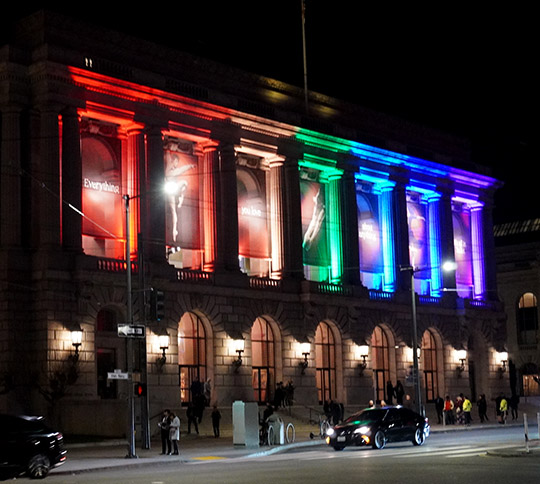
Last Friday was a Gay Night Out at the San Francisco Ballet and the Opera House was lit up accordingly.
The third of three programs in the next@90 Festival of new ballets began with Kin by choreographer Claudia Schreier and a commissioned score by the young California composer Tanner Potter. I liked all the contemporary music on the evening's program, including Kin with its succession of swelling fanfares.
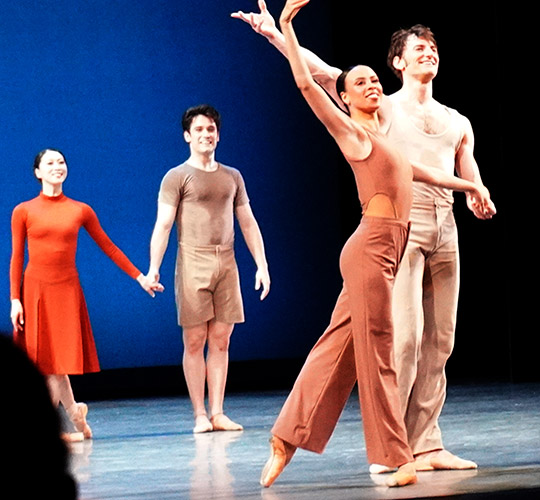
All three of the ballets were abstract but seemed to be based on private narratives, including Kin with its two couples and attendant tribes mixing and matching and struggling with each other. Pictured are principal dancers Isaac Hernández and Aaron Robison...
...who partnered Dores André and WanTing Zhao respectively (pictured above). It's possible the ballet was about a same-sex longing between the two women and their partners' and community's vehement disapproval, but that could be totally wrong. In any case, the impossibly tall and elegant WanTing Zhao was worthy of worship by everyone, and casting her as the Austere Queen of Program 1's Resurrection would be fun to see.
The second ballet was Gateway to the Sun, choreographed by Nicholas Blanc to a 2019 score for cello and orchestra by Anna Clyne entitled Dance. Max Cauthorn played a poet, based on Rumi, who watches and occasionally interacts with scenes from his poems, none of which was particularly clear. Sasha de Sola and Jennifer Stahl are flanking the blue poet in the photo above.
The choreography was not as interesting as Clyne's music, and the unisex costumes were unflattering for all genders, but the dancing ensemble was superb, and Jennifer Stahl (above, partnered by Luke Ingham) was entrancing.
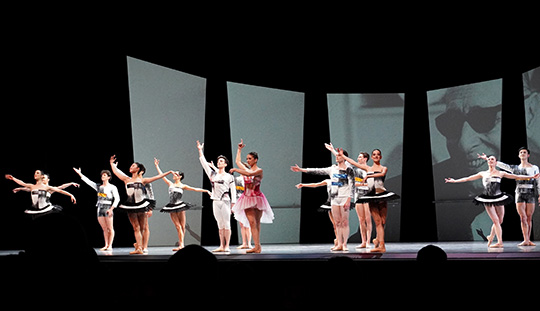
The final ballet was Yuri Possokhov's take on Stravinsky's 1931 neoclassical Violin Concerto, set in a ballet studio.
This was another abstract ballet that seemed to have an underlying narrative that boiled down to Everybody Loves Joseph Walsh (above right), including a Muse in pink danced by Sasha Mukhamedov, and Wona Park as his original girlfriend. It was a gay, lovely evening.
Subscribe to:
Posts (Atom)