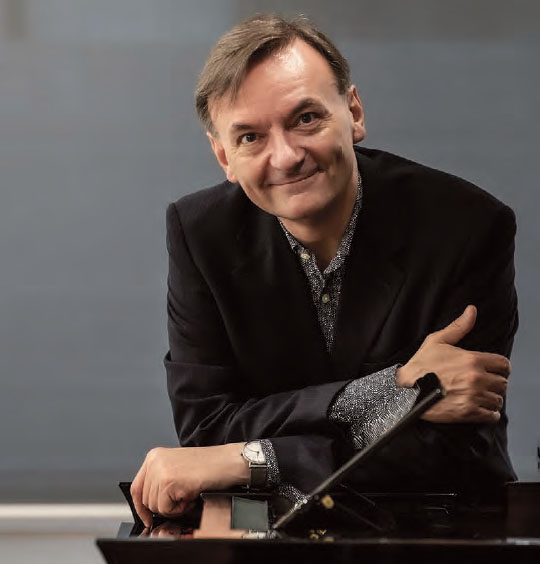
The invaluable San Francisco Performances presented British pianist/composer/writer/polymath Stephen Hough with the London-based Castalian Quartet on Tuesday at Herbst Theater. It was a weirdly disappointing concert. (Pictured are Hough and cellist Steffan Morris.)
Originally scheduled for separate concerts last November, Hough and the London-based string quartet both had to cancel and they somehow decided to join forces for a short tour of California and New York. The program was similar to the last time I saw Hough when he joined the Takács Quartet in Berkeley (click here). Two years ago, the performance started with a Haydn string quartet, followed by the world premiere of Hough's own String Quartet #1, and finished with Dvorak's Piano Quintet No. 2. Tuesday's performance started with a Haydn string quartet (F Minor, Opus 20, No. 5), followed by Hough's String Quartet #1 again, and finished with Brahms's Piano Quintet in F Minor, Opus 34.
The big problem in Tuesday's performance was that the first violinist was having intonation problems all evening, and the occasional sour notes were impossible to hide in Haydn's transparent music. It was nice to experience Hough's string quartet again, and the neo-Poulenc set of six French souvenirs holds up well on a second hearing.
Hough joined the quartet for the Brahms piano quintet, and his impeccable musicianship seemed on a different wavelength than the quartet who opted for aggressiveness rather than a pretty sound. By the final movement, Hough seemed to give up and just join the fray, pounding his poor instrument in a way I've never seen from him before.
Showing posts sorted by relevance for query stephen hough. Sort by date Show all posts
Friday, March 08, 2024
Wednesday, February 23, 2022
Stephen Hough and the Takács Quartet
Cal Performances hosted a full, appreciative crowd at UC Berkeley's Hertz Hall on Sunday afternoon for a concert by the Takács Quartet. My concert companion, James Parr, was wallowing in nostalgia over his undergraduate years where he had taken classes and performed with the university chorus in this same hall two decades ago. He was amusingly one-upped by the white-haired woman sitting next to him who had been at the 1953 opening of the lecture/concert hall when she was a freshman.
The string quartet formed in 1975 after meeting each other at the Music Academy in Budapest, Hungary. In 1983, they were offered a quartet-in-residence gig at the University of Colorado, Boulder, which is still the group's home base. The roster has changed over the years due to retirement and death, and the current group consists of: Richard O'Neill, viola (since 2020); András Fejér, cello (the only original member); Harumi Rhodes, second violin (since 2018); and Edward Dusinberre, first violin (since 1993). I had never heard the group before, although their name was familiar on account of Geraldine Walther, the beloved principal viola at the SF Symphony who jumped ship and joined the quartet in 2005.
The program began with a late Haydn Quartet, "Sunrise," which they performed with lots of dramatic flourishes, but I was not particularly impressed with their sound which felt heavy and muddy rather than illuminating. This, I must hasten to add, was a minority opinion because most of the musically sophisticated audience were on their feet for a standing ovation at the end.
They followed with a newly commissioned quartet by the polymath pianist/writer/composer/painter Stephen Hough. The quartet was recording the Ravel and Dutilleux string quartets and asked Hough for something to fill out the CD with his first string quartet. Hough's inspiration was the music of "Les Six," the sextet of French musicians between World War I and II who were lumped together as a group, and his six-movement work was thoroughly delightful, alternating between Gallic wit and British Catholic gay angst. I hope to hear it again.
Hough stayed busy during the pandemic. Rough Ideas is a recently published collection of his newspaper articles, blog posts, and observational jottings written in airports, hotels, and green rooms around the world. My favorite Francis Poulenc anecdote is included, and Hough's String Quartet No. 1 emulates a lot of its flavor. "A reliable, reputable source told me once of an occasional routine of Poulenc. In the late afternoon he would leave his apartment and go to the park where he would have a lustful tumble behind a bush with a willing soldier. He would then cross the park into the shadows of the Catholic church where he would slip into a dark confessional. After being absolved of his sins, and less than an hour after first leaving home, he would return to a sumptuous supper, all ready to be served along with a decanted bottle of fine red Bordeaux."
The second half of the program was Dvorak's Piano Quintet No. 2. Working from home, I often listen to a livestream of Bartok Radio from Budapest, and this work seems to be broadcast at least once a week, which is fine because it's so gorgeous. Hough was the pianist for the performance, and he was on a different, more brilliant musical plane than the strings, but it didn't matter. If you ever get a chance to hear him play piano live, do so, and Alex Ross at The New Yorker agrees with me.
The string quartet formed in 1975 after meeting each other at the Music Academy in Budapest, Hungary. In 1983, they were offered a quartet-in-residence gig at the University of Colorado, Boulder, which is still the group's home base. The roster has changed over the years due to retirement and death, and the current group consists of: Richard O'Neill, viola (since 2020); András Fejér, cello (the only original member); Harumi Rhodes, second violin (since 2018); and Edward Dusinberre, first violin (since 1993). I had never heard the group before, although their name was familiar on account of Geraldine Walther, the beloved principal viola at the SF Symphony who jumped ship and joined the quartet in 2005.
The program began with a late Haydn Quartet, "Sunrise," which they performed with lots of dramatic flourishes, but I was not particularly impressed with their sound which felt heavy and muddy rather than illuminating. This, I must hasten to add, was a minority opinion because most of the musically sophisticated audience were on their feet for a standing ovation at the end.
They followed with a newly commissioned quartet by the polymath pianist/writer/composer/painter Stephen Hough. The quartet was recording the Ravel and Dutilleux string quartets and asked Hough for something to fill out the CD with his first string quartet. Hough's inspiration was the music of "Les Six," the sextet of French musicians between World War I and II who were lumped together as a group, and his six-movement work was thoroughly delightful, alternating between Gallic wit and British Catholic gay angst. I hope to hear it again.
Hough stayed busy during the pandemic. Rough Ideas is a recently published collection of his newspaper articles, blog posts, and observational jottings written in airports, hotels, and green rooms around the world. My favorite Francis Poulenc anecdote is included, and Hough's String Quartet No. 1 emulates a lot of its flavor. "A reliable, reputable source told me once of an occasional routine of Poulenc. In the late afternoon he would leave his apartment and go to the park where he would have a lustful tumble behind a bush with a willing soldier. He would then cross the park into the shadows of the Catholic church where he would slip into a dark confessional. After being absolved of his sins, and less than an hour after first leaving home, he would return to a sumptuous supper, all ready to be served along with a decanted bottle of fine red Bordeaux."
The second half of the program was Dvorak's Piano Quintet No. 2. Working from home, I often listen to a livestream of Bartok Radio from Budapest, and this work seems to be broadcast at least once a week, which is fine because it's so gorgeous. Hough was the pianist for the performance, and he was on a different, more brilliant musical plane than the strings, but it didn't matter. If you ever get a chance to hear him play piano live, do so, and Alex Ross at The New Yorker agrees with me.
Thursday, February 06, 2025
Stephen Hough Plays Liszt and Chopin
The 63-year-old British pianist Stephen Hough brought his formidable Liszt/Chopin sonata recital program to the Herbst Theater on Tuesday evening, sponsored by the invaluable San Francisco Performances. Hough is an official MacArthur Fellowship genius, a brilliant writer, a musical composer/arranger, a colorful painter, and above all a frighteningly accomplished pianist. He's also gay, a Catholic convert, and has often longed to be a priest or a Franciscan monk.
Hough sometimes champions overlooked 19th century composers, usually French, and this concert started with three piano pieces by Cécile Chaminade (1857-1944): Automne, Autre fois, and Les sylvains. Chaminade's style is reminiscent of Camille Saint-Saëns, and she was a prolific, accomplished composer whose music was demeaned both because of her gender and because her style went out of fashion once the 20th century arrived. The trio of works were all interesting and it would be great to hear more of her work.
This was followed by Franz Liszt's strange, craggy, monumental Piano Sonata in B Minor (1853), 30 minutes of uninterrupted piano drama that I had somehow never heard before. Hough's performance was loud and dramatic, which suited the music, and by the end of the performance a friend said, "My fingers started hurting just watching that."
I could have happily gone home fulfilled after the first half, but there was more after an intermission. Hough wrote a short, three-movement piece called Sonatina Nostalgica for an old friend's 70th birthday, evoking their shared childhood village of Lymm in Northwest England. This was the first time he spoke to the audience, describing the place and the piece, and it was also the only time he used a (digital) score while playing. Everything else on the program he had somehow memorized.
Bookending the Liszt, he finished with Chopin's final major work, the 1844 Piano Sonata No. 3 in B Minor. I still had the Liszt performance jangling in my brain so it was hard to concentrate on the Chopin. It started feeling like "too many notes," like the apocryphal story about Emperor Joseph II and Mozart.
There were two encores, the Warum movement from Schumann's Fantasiestücke and Hough's own insanely virtuosic fantasia on the Mary Poppins song Supercalifragilisticexpialidocious.
Hough sometimes champions overlooked 19th century composers, usually French, and this concert started with three piano pieces by Cécile Chaminade (1857-1944): Automne, Autre fois, and Les sylvains. Chaminade's style is reminiscent of Camille Saint-Saëns, and she was a prolific, accomplished composer whose music was demeaned both because of her gender and because her style went out of fashion once the 20th century arrived. The trio of works were all interesting and it would be great to hear more of her work.
This was followed by Franz Liszt's strange, craggy, monumental Piano Sonata in B Minor (1853), 30 minutes of uninterrupted piano drama that I had somehow never heard before. Hough's performance was loud and dramatic, which suited the music, and by the end of the performance a friend said, "My fingers started hurting just watching that."
I could have happily gone home fulfilled after the first half, but there was more after an intermission. Hough wrote a short, three-movement piece called Sonatina Nostalgica for an old friend's 70th birthday, evoking their shared childhood village of Lymm in Northwest England. This was the first time he spoke to the audience, describing the place and the piece, and it was also the only time he used a (digital) score while playing. Everything else on the program he had somehow memorized.
Bookending the Liszt, he finished with Chopin's final major work, the 1844 Piano Sonata No. 3 in B Minor. I still had the Liszt performance jangling in my brain so it was hard to concentrate on the Chopin. It started feeling like "too many notes," like the apocryphal story about Emperor Joseph II and Mozart.
There were two encores, the Warum movement from Schumann's Fantasiestücke and Hough's own insanely virtuosic fantasia on the Mary Poppins song Supercalifragilisticexpialidocious.
Friday, May 15, 2015
Stephen Hough Plays Chopin and Debussy at SFJAZZ
The British pianist Stephen Hough above just spent a fortnight performing a piano recital of music by Chopin and Debussy. According to Hough's blog entry about the concerts, it was "London on Tuesday, then Manchester and Glyndebourne; and the following week Boston, New York and San Francisco." The final concert was hosted by San Francisco Performances and held in the relative intimacy of the SFJAZZ Center, which made most of those attending feel very lucky.
The program was unusual, with the four Ballades of Chopin in the middle surrounded by Debussy pieces, with La plus que lente and Estampes in the front and Children's Corner and L'isle joyeuse in the back. It turned out to be an inspired stroke of programming, though, and the concert grew more absorbing and virtuosically difficult as it went along, with a sweet respite at the Children's Corner before the voluptuous island finale which Debussy confessed, "Lord, but it's difficult to play."
Hough writes about the two composers on the program:
"They were both romantics on the surface but underneath Chopin was a classicist in his tastes...whereas Debussy was, arguably, the first modernist (hat tip: Pierre Boulez) with his revolutionary approach to form and harmony and his exploration of a musical language fragmenting into a new vocabulary and meaning...
The [Chopin] Ballades are stories – epic tales, in scope if not in length, operas in miniature. All of the Debussy pieces are poems, vastly suggestive beyond their duration in time or their presence in aural space."
Hough is one of the most technically amazing pianists I have ever witnessed, and there were moments in the quicker sections where his hands turned into virtual motion blur in front of your eyes, all while maintaining the most perfect musical clarity. Add to this a scary-smart intelligence along with beautiful musical instincts and you have an artist who is very special. The performance surpassed expectations, and the extraordinarily quiet and attentive audience gave him the attention he deserved.
Thursday, February 05, 2009
Stephen Hough and David Robertson at the Symphony
The San Francisco Symphony's program this week is a very hearty stew, with the first half devoted to Tchaikovsky's rarely heard Second Piano Concerto played in spectacular fashion by the 47-year-old British/Australian pianist Stephen Hough (above left) and conducted by David Robertson (above right), who is currently music director of the Saint Louis Symphony.
The program notes by Michael Steinberg start with, "I would guess that nine out of ten people at this concert are hearing Tchaikovsky's Second Piano Concerto for the first time," and Steinberg was probably right. Charlie and Cedric (above) had never heard the huge, 50-minute piece before and neither had I, which just made the performance that much more exciting.
The long first movement was highlighted by some of the most virtuosic playing I've ever seen by a pianist. Hough's hands were moving so fast at certain points that they looked photographically blurred. From what I could hear and see on his amusing website (click here), he fully deserves his 2001 MacArthur Fellowship for "genius." The man is not only one of the greatest pianists in the world but he composes music, writes essays, poetry, scholarly books, and even an impassioned defense of being an openly gay Catholic.
The second half consisted of Sibelius' first tone poem, "En Saga," in a really marvelous performance by the orchestra. It sounded bizarrely modern at times, and you could easily make out what the contemporary composer John Adams has (admittedly) lifted from Sibelius over the years. This was followed by Scriabin's 1908 "The Poem of Ecstasy," which was fun but entirely too much after the Tchaikovsky and Sibelius. We left feeling thrilled but a bit overstuffed.
Sunday, January 06, 2013
San Francisco Symphony Preview 2013
In a Santa Cruz forest way back in the 1970s, I was once the guest of an elderly ceramicist who puttered around naked from house to kiln to art studio, while he listened to mostly contemporary chamber music being broadcast from a turntable through a series of speakers spread across an acre of property. "Do you really listen to this stuff for pleasure?" I asked, because most of the music sounded so astringent and dissonant to my young, autodidact self who was just discovering Verdi and Mozart. "Oh yes, very much so," he replied. "As I've gotten older, my tastes have become more adventurous. A lot of the music I loved as a young man sounds stale now. Wait and see, it will probably happen to you too."
The above anecdote is a roundabout way of explaining that the San Francisco Symphony offers something for everyone, from beginner to sophisticate, in the second half of its 2012-13 season, and I have tried to offer a guide for both. Sitting at a symphonic concert means seriously concentrating on music, rather than just having it as background for work or drink or socializing. That means the same piece can be a revelation for newer ears and intensely boring for those who have heard it too many times. The elderly ceramicist turned out to be right.
Following are a few San Francisco Symphony concert suggestions for a relative beginner over the next six months:
1. Soprano Renee Fleming (above center, backstage at Lucrezia Borgia at the SF Opera) is singing a bunch of French songs this week, with Tilson Thomas conducting Debussy's La Mer. January 10-12.
2. Charles Dutoit conducting Ravel, Lalo, and Elgar's Enigma Variations. January 31-February 1.
3. Michael Tilson Thomas conducting, Yuja Wang on piano playing Beethoven (Piano Concerto #4) and Brahms (the First Symphony). March 6-8.
4. Herbert Blomstedt, getting even better as he becomes more ancient, conducting two weeks of Wagner (Tristan selections), Beethoven (Symphony #3 and the Violin Concerto) and Nielsen (Symphony #5). April 11-20.
5. Beethoven Project: Tilson Thomas leads a mini-festival of early Beethoven works. May 2-11.
6. Marek Janowski conducts Brahms (Double Concerto) and Schumann (Symphony #4) May 15-18.
7. David Roberts conducting and Mark-Andre Hamelin on piano, playing Gershwin (Rhapsody in Blue) and Ravel (Left Hand Piano Concerto and La Valse), with a dollop of Elliott Carter to start things off (don't be afraid). May 22-25.
8. Juraj Valcuha conducting and Gautier Capucon on cello playing Dvorak (Cello Concerto and Symphony #9). June 1.
9. Bernstein's West Side Story in concert, which strikes me as a dubious proposition, since all my favorite live versions over the years have been high school student productions, where youthful energy was half the excitement. June 29-July 2.
And now, for concerts this jaded old character is excited about, let's start with the semi-staged, multi-media, Michael Tilson Thomas mashup of music written by three composers for Peer Gynt, Ibsen's five-hour poetry play from 1876. This will include selections from the original incidental music written by fellow Norwegian Edward Grieg in the first half of the program, followed by excerpts from a 1980s Peer Gynt ballet by Alfred Schnittke, and a world premiere by British composer Robin Holloway. The entire event could turn out to be a disaster, but at least it will be an ambitious one. The Symphony Chorus will be singing alongside a pair of actors and soprano soloist Joélle Harvey (seen above at Fort Mason when she was singing Zerlina in Mozart's Don Giovanni with the Merola Opera program). January 17-19.
I have sworn off dreary Requiems for a while, but there's plenty of other bright liturgical music, including the beautiful, rarely heard pieces being conducted in early February by Charles Dutoit (above right). He pairs Poulenc's light-footed 1950 Stabat Mater for chorus and soprano with Berlioz's massive Te Deum for multiple choruses, orchestra, organ, and soloists (Erin Wall and Paul Grove). February 6-10.
Soon after, conductor Pablo Heras-Casado (above right) conducts a recent Magnus Lindberg work called EXPO, the extraordinary British/Australian pianist Stephen Hough (above left) plays Liszt's Second Piano Concerto, and the concert winds up with a wild, favorite Prokofiev symphony, the Fifth. February 14-17.
Though Davies Hall is usually too large a barn for successful Mozart and Handel performances, there are exceptions, especially when the great Symphony Chorus is involved. In April, Canadian conductor Bernard Labadie (above right, with chorus looming over him) will be conducting Mozart's Symphony #39 and a rare motet by the same composer, Ave Verum Corpus. The second half features Handel's paean to the power of music, Ode for St. Cecilia's Day, with soloists Lydia Teuscher and Nicholas Phan. April 5-6.
In June, conductor Kirill Karabits above is conducting Honegger's Pacific 231, Britten's Double Concerto with Symphony principals Alexander Barantschik and Jonathan Vinocour (above left) as soloists, and the crowd-pleasing Sibelius Second Symphony. I will be going for the Britten, who is being shamefully ignored on his 100th birthday anniversary around San Francisco this year. Please, local arts programmers, I have a few requests, such as hearing Britten's marvelous Spring Symphony live at Davies Hall. And while we're at it, the SF Ballet and choreographer Mark Morris need to take on the full-length Prince of the Pagodas, while the SF Opera would be a perfect setting for Britten's Queen Elizabeth opera, Gloriana. And Opera Parallele, it's time to find a small San Francisco church venue, where you can perform the Church Parables and Noye's Fludde and Saint Nicholas, with a combination of students and professionals. June 6-9.
In late June, Tilson Thomas will lead a changing set of all-Stravinsky concerts. The most interesting look to be the ones featuring the Dmitri Pokrovsky Ensemble, joining the orchestra for Renard, Les Noces, and Russian folk songs, followed by The Rite of Spring. June 21-22. See you at the concert hall.
Wednesday, February 13, 2013
Coming to Town
The ancient Chinese Terracotta Warriors and their accoutrements are being unpacked and installed at the Asian Art Museum this week in anticipation of next week's opening.
The marketing of the exhibit has literally been all over the map and will include a donor's party on the 20th and a dance party on Thursday the 21st that features a tenuous tie-in to the cult 1979 Walter Hill New York gang movie The Warriors. (For a British website dedicated to the crazy film, click here.)
Also coming to town are new directors for the San Francisco Girls Chorus at Page and Market. It's going to a dual directorship, with the San Francisco raised, New York based singer/composer Lisa Bielawa above left as the new Artistic Director, and Valerie Sainte-Agathe above right from Montpellier, France taking over as the daily Music Director and Principal Conductor. The manner in which the organization got rid of their last artistic director, Susan McMane, was a clumsy fiasco (click here), so it's great news that Bielawa is joining the organization.
Continuing with the French invasion, Emmanuel Morlet above will be the new Artistic Director at Sonoma State's Green Music Center, with its beautiful new Weill Hall, leaving his position in New York as Director of the Music Office for the Cultural Services of the French Embassy. Why can't I have I have a job like that, just for the job title alone?
Finally, a host of performances are coming up this week that are all special. The SFJAZZ Center is opening up its ground-floor, glass-enclosed Joe Henderson Lab above on Thursday, Valentine's Day with the SFJAZZ Hotplate Festival for four nights. Also this week is Philharmonia Baroque playing unfamiliar Haydn, Mozart and C.P. Bach symphonies around the Bay Area, the San Francisco Symphony has an interesting concert featuring Lindberg, Prokofiev, and the great pianist Stephen Hough playing Liszt, and Opera Parallele is presenting Ainamadar by Osvaldo Golijov at Yerba Buena this weekend. Though not ordinarily a fan of Golijov's music, I have been listening to the Dawn Upshaw recording on the one-act opera all week and the piece is really growing on me. It will be great to experience it live.
Thursday, October 29, 2009
Osmo and Vadim at the San Francisco Symphony
Most of the beautiful usual suspects were at the San Francisco Symphony concert on Wednesday evening, which started with the San Francisco debut of contemporary Finnish composer Aulis Sallinen's first symphony. This was followed by the Sibelius violin concerto, with Beethoven's "Coriolan Overture" and eighth symphony holding down the second half.
This was the second week of concerts led by the Finnish conductor Osmo Vanska who is usually found at the Minnesota Orchestra where he's the music director. The reports on last week's concert of Adams, Tchaikovsky and Dvorak were all over the map, but mostly laudatory. The Sallinen symphony, which he wrote at the age of 35 in 1971, is a mostly tonal fifteen-minute piece that just gets more beautiful as it goes along, with tubular bells and a marimba playing off an extensive percussive section. The stamp of Sibelius was all over the symphony, particularly in its use of strings and horns, but Sallinen seems to have his own, otherworldly voice. Please, let us have one of his other eight symphonies or six operas, and bring Osmo back to conduct them.
The Sibelius violin concerto from 1905 is a dramatic, overplayed warhorse that I love, partly because it sounds so different depending on who is having a go at it. This week's soloist is the 38-year-old Siberian superstar Vadim Repin who played the piece exquisitely, with a total lack of schmaltz.
The only problem was that Vanska and the orchestra seemed to be playing another version of the concerto altogether, a wonderful interpretation on its own but not at all integrated with the soloist. There were a few moments, particularly at the end of each movement, where soloist and orchestra blended rather than contrasted but most of the concerto was a strange back-and-forth between restraint and excitement.
Cedric Westphal (above) had an amusing interview with Vadim last week (click here) where the violinist confessed to having just flown into Helsinki after performing in Melbourne, Australia, which was to be followed by a flight to San Francisco for these concerts. By Friday and Saturday's concerts, he'll probably know which continent he is in.
The great British pianist Stephen Hough is currently writing a blog for The Telegraph newspaper that is funny, smart and approachable (click here). In a recent post, he confessed:
"I don’t get Bach, even whilst I understand his towering genius...but I do get Mompou. Perhaps it’s like friendship, we just like certain people and not others; we resonate with certain composers; we are touched by the cracks between their notes; their music has a ’smell’ with which seduces us, leading us willingly into submission beyond analysis or logic. A composer we love is one where we treasure even the dross, even as we recognize that it is dross. Tchaikovsky is one such composer for me."
The composer I don't enjoy "even whilst understanding his towering genius" is Beethoven. The fact that his music is overplayed may be part of the problem, but it really is a matter of taste. My date for the evening, however, thoroughly enjoyed the Coriolan Overture and Eighth Symphony, and so did the "non-scary-German" over at Not For Fun Only.
The Friday repeat won't feature the Sallinen symphony, which is too bad since it is a rare highlight. The symphony will be played again at the Saturday concert at Flint Center in Cupertino, though, so if you live in the South Bay, it's highly recommended.
Monday, February 11, 2013
Catholic Musical Sensuality
In the first chapter of the supremely witty, gorgeously written Memoirs of Hector Berlioz, the 19th century French composer wrote:
"Needless to say, I was brought up in the Catholic and Apostolic Church of Rome. This charming religion (so attractive since it gave up burning people) was for seven whole years the joy of my life, and although we have long since fallen out, I have always kept most tender memories of it. Indeed, such is its appeal for me that had I the misfortune to be born into the bosom of one of those schisms ponderously hatched by Luther or Calvin, I would undoubtedly have abjured it the moment I was able and flung myself into the arms of the fair Roman at the earliest promptings of poetic instinct."
Last week, the San Francisco Symphony offered one of the most remarkable programs in their history with a pair of rarely heard French Catholic choral masterpieces conducted by the Swiss/French/Canadian conductor Charles Dutoit. The concert started with the first SF Symphony performances of Francois Poulenc's Stabat Mater, sixty years after its 1951 premiere, an odd omission for such an exquisite piece of music.
Maybe it's because Poulenc's reputation as a masterful composer is still taking time to establish itself. A rich, gay, French Catholic, miniaturist, mostly self-taught composer who wrote operas for cabaret singers overlaps too many categories and is not to be taken seriously, so it's taken decades for the world to catch up. The similarly brilliant gay, British Catholic piano virtuoso Stephen Hough recently wrote a blog post at The Daily Telegraph called The Three Faces of Poulenc that is an amused appreciation of the composer's musical and holistic synthesis. It begins:
"A reliable, reputable, scholarly source told me once of an occasional activity of Poulenc when staying in Paris. In the late afternoon he would leave his apartment and go to the local park where he would have an anonymous encounter. He would then cross the park to the Catholic church where he would slip into a dark confessional. After being absolved of his sins, and less than an hour after first leaving home, he would return to a sumptuous supper, all ready to be served along with a decanted bottle of fine, red Bordeaux."
Listening to Poulenc's music, it is easy to hear his religious feelings are sincere. What is odd and charming is his integration of the spiritual with the sensual and sardonic, putting him far ahead of the institutional Catholic Church which is still officially demonizing people like him. So in honor of the first resignation of a pope today in 600 years, I will play Poulenc's joyous cantata, Gloria, to celebrate. (Photo above is of Ragnar Bohlin, Symphony Chorus Director, and Erin Wall who was the soprano soloist. They both did themselves proud.)
The second half of the SF Symphony's concert was Berlioz's massive 1849 Te Deum, which had not been performed in 40 years, another shameful omission because this piece is Berlioz at his greatest. Then again, the radical 19th century composer is still being absorbed into the world's cultural bloodstream. The first performance of this piece didn't occur until almost seven years after he had written it because of the money and the politics involved, and since then it has mostly disappeared as a repertory staple. The performances by the huge forces on Saturday night at Davies Hall were magnificent, and the music surpassed all expectations for beauty and strangeness, mixing delicacy and huge, bombastic effects seamlessly, decades before Mahler played with the same dynamics.
Dutoit, pictured below, is a jet-setting, veteran star conductor who can either phone it in or provide serious inspiration, and it was the latter who was on the podium last week, leading the San Francisco Symphony Chorus in one of their greatest performances.
In the first chapter of Berlioz's Memoires, he also writes about his first communion where he encounters the disgusting sexism of the Church and also receives a glimpse of heaven:
"It was spring: the sun shone brightly, a light wind stirred the rustling poplars; the air was full of some religious fragrance. Deeply moved, I crossed the threshold of the chapel. I found myself in the midst of a multitude of young girls in white, my sister's friends; and with them I knelt in prayer and waited for the solemn ceremony to begin. The priest advanced, the Mass commenced; I gave myself to God. I was rudely awakened by the priest summoning me--with that boorish, unthinking bias in favour of their own sex that some men had even at the Lord's table--to come up to the altar first, in front of all those charming girls. I felt sure they should have precedence; but I went up, blushing at the unmerited honour, and received the sacrament. As I did so, a chorus of fresh young voices broke into the eucharistic hymn. The sound filled me with a kind of mystical, passionate unrest which I was powerless to hide from the rest of the congregation. I saw Heaven open--a Heaven of love and pure delight, purer and a thousand times lovelier than the one that had so often been described to me. Such is the magic power of true expression, the incomparable beauty of melody that comes from the heart!"On Saturday night at Davies Hall, during the final, wild Judex crederis movement of the Te Deum, I also saw Heaven open, and would like to thank everyone involved, especially Hector.
Subscribe to:
Posts (Atom)